

By Avery Gibson
Spring 2022
Menstruation is the only blood that is not born from violence, yet it’s the one that disgusts you most.
Maia Schwartz, artist
Menstruation and having to go through menstruation is a diverse topic. For one, it is a miraculous gift. It is the reason we are all here today living and breathing and if menstruating wasn’t a part of everyday life, nothing would exist. Even though it is one of the miracles of the natural world; it can be the biggest curse. The twist in a young girl’s stomach when the teacher rudely says “You do not need your bag to go to the bathroom” after waiting too long to change your pad is a result of ignorance; a lack of knowledge on society’s part that young women are having to pay for has gone one too long. The sadness a mother feels when she has to choose feeding herself and/or her family over sanitary products because they are not covered by food stamps, medicaid, or insurance is a feeling no woman should ever go through. This is a reality in our world because of the booming industry of period products and the stance of our government when it comes to seeing those products not as a necessity but as a privilege. Educating the population as a whole, not just those who menstruate, is a must. When there is a lack of knowledge, it leaves room for misconception. The only way to really get a clear understanding of what knowledge our peers have on periods is to talk to them. These are the people we live day to day with, yet we all have different experiences on what periods are to us, it is my goal to look into those differences and similarities. I will be conducting an array of interviews with both men and women; my interviews will consist of biological and sociological questions about menstruating to determine the amount of knowledge on the topic. I will also shed light on what Oklahoma State University is doing to combat what the world has done to periods. OSU has broken through walls when it comes to demolishing the stigmas of periods and have shown their support of those who menstruate by starting the Red Pantry Committee. The Red Pantry Committee has multiple spots on campus for those in need to come get pads and tampons. They also host informational get-togethers to educate and reach out to those wanting to learn more about periods. I will be interviewing the committee members to dive in deeper and get a better look as to what OSU is doing for half of their attendees. Again, because it is worth saying twice, no one would be here if it weren’t for period, thank God for periods.
Immediately after getting her first period, a young girl either knows or is directly told to not talk about it; especially not above a whisper and/or around men. This sends an automatic heavy blanket of guilt, shame, and embarrassment over top any joy that could’ve come from finally embarking on what should be a miraculous experience. I remember the day when all the fifth graders were separated into two categories, boys and girls, to watch ‘the video’. I was excited and hopeful to finally learn a bit and to maybe be more prepared for what I knew was coming. I was disappointed. I was disappointed when the whole video was about how to get a non-see-through bag for our sanitary products so no one can tell what we were going to the bathroom for and how we can make code words with our teachers so that no one would know. At the end of the video, the teachers made us promise to not tell the boys what we just watched.
I was furious, I felt ashamed and embarrassed and that is the moment I started dreading the day my stupid aunt flo would come to town. The start of the stigmas surrounding menstruation starts at a young age, which means it can so easily be prevented by educating everyone, men and women, the right way. The same can be said about tampon and pad advertisements, shame is so deeply intertwined in them; The main goal of these ads is concealment. They steer away from showing the actual product, or even just the bathroom where the products are kept, and the actual period will not be shown either (Kissling 484). Not that women don’t appreciate the privacy but the connotation that comes with the concealment is loud. A lack of education leads to myths, misconceptions, and misinformation. The biology of periods and the sociology of periods are surely connected. Not only do women have to deal with the biology, the mini heart attack pain level cramps, the bleeding, the cleanliness, hormones, etc. but women have to also deal with the sociological side; missing work/school, the bullying in k-12, and the embarrassment. Anthropologists therorized how the stigma surrounding periods immeraged; before we had the knowledge and tools that told us women bled due to their reproductive cycle, there must have been a wild amount of confusion. Women would bleed without a wound and for roughly 5 days without being weakened or ill. No wonder men cried witch, “Because men did not experience menses themselves, they must have been afraid of it, perhaps worried that close contact with menstrual blood might do them some physical damage or pollute them by its association with the mysterious female body. Thus, menstruation may have seemed poisonous” (Johnston-Robledo, Chrisler 9-18). Although it may sound silly now that men could’ve thought periods were evil, the same issue is present just a little tinkered to fit our generation. Back then, it was just known that women bled once a month; compared to now we have boat loads of information on the topic.
But is everyone still uneducated? I conducted interviews with men and women about their knowledge and personal opinions on menstruation to understand different viewpoints. For confidentiality reasons, I will be typing up parts of the manuscript from the interviews and giving the interviewees aliases. It quickly became clear to me that the majority of the public, men and women, had little to no knowledge on menstruation, and I too am included in that group. It wasn’t until my first year of college did I learn that when an egg in the ovary is mature and ready to go down the fallopian tube, it bursts a hole throught the ovary to get to the tube and then eventually down to the uterus. I remember being so stunned hearing that and then I looked around at the faces of all the girls in my class. They were all wearing the same face of shock that I had on.
Most women are not taught about periods until they wake up with mysterious pain and bleeding, which creates a wave of fear as an introduction to something they will have to ‘deal with’ for almost a quarter of their lives.
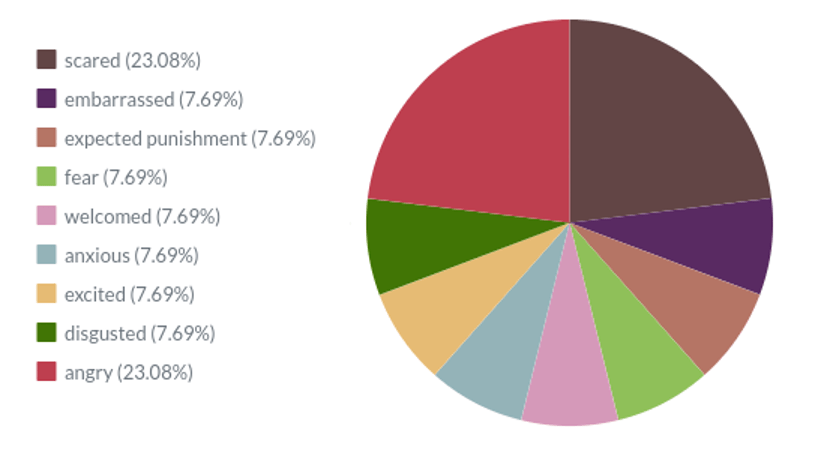
Most of the responses were expected and it was found that those who came from a long line of women (mostly girls who had older sisters and a close bond with their mothers) had a more pleasant experience with their menarche (the first period) than other women. This trend of experiencing overwhelming fear at the arrival of the menarche can be cut in half with the proper education and normalization of what comes with a period.
I asked men and women what words come to mind when they think of periods; the pink word cloud is for women and the blue word cloud are the mens responses.
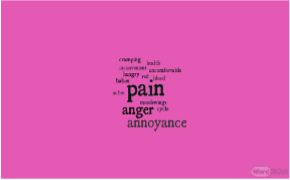

It is understandable that men have a limited vocabulary when it comes to periods but what is interesting is the emotions associated with the words women have picked.
Women and girls often find themselves missing school and/or work due to period pain or other issues that come about by not having appropriate resources. During my interview process I found that every woman I interviewed has had an experience where living with a period has held them back from their school or work duties. We are taught to not let period issues deter us from responsibilites and to never use it as an excuse but that brings up my question; Is this a response to living in a patriarchal society that doesn’t recognize the severity of periods and are women pushing themselves beyond what is needed just so that they aren’t seen as weak or incapable? It reminds me of the time my mother told me about her work life when she was pregnant; She said that she worked as long as she could and even over maternity leave because she didn’t want having children to hold her back and she didn’t want her status at work, that she worked so hard to achieve, to change. She was well respected around her office but overworked herself during on of the most exhausting times of her life so that the men didn’t see her differently.
One interview response stood out to me:
Me: have you ever needed to leave school for period reasons? Cramping, bleeding, anything? And were you told no before?
Amanda (alias): Um, yes i have had to leave school for various reasons multiple times. Whether that be I didn’t have the products I needed at school or I wasn’t feeling good. I have been told no by teachers but my mom would call and my mom has always been supportive luckily. But there were times where i have asked to go to the bathroom and my teachers told me no.
…. Amanda: Going to the bathroom is a necessary exert for female students to readjust and use sanitary products because you can’t control what happens at every second of the day. And there had been times where I had gone up to a male teacher, or even a female teacher, and asked to go to the bathroom and when they said no, I would say it’s an emergency I am on my period. And after saying that they would often respond accusing me of faking a period to get out of class and some of them would even go as far to track my periods to monitor if I was on my period or just trying to get out of class. You know, I would always be like “what”.
Moments like these not only distract women from their course work but also publicly embarrass them. We live in a society built for living, not living with periods, as half the population does. We have just the same amount of sick days at work and excused absents at school as men. A group of women volunteered for a period cramp study. This study involved them placing a pressure catheter up into their uterus throughout the whole duration of their menstrual cycle (first day of their period to the first day of their next period). It was found that the pressure generated in the uterus during the period is 120 mmHg. This is equivalent to the pressure generated in the second stage of full blown labor while pushing (Gunter). Studies like this can contribute to a greater understanding of what 50% of the world goes through. Even if we are starting a bit late, this type of knowledge and actually putting numbers to what is normally just seen as a ‘complaint’ can create such a difference.
Among the physical and emotional affects, there is also a heavy economic set back when it comes to living life with a period. Period poverty; Inadequate access to menstrual tools and education like products, waste management, and access to appropriate washing facilities (Davies M.D., Lewis J.D, Clarke). Period poverty is a sad reality faced by 1 out of 5 women in America today. This issue has gone on for years but the recent Coronavirus pandemic has put even more stress on those who struggle affording menstrual products. Some young women have had to depend on the pads and tampons provided by their schools and some outside organizations, even if the tampons were made of cardboard and are insanely uncomfortable and/or painful. Due to Covid-19, schools and organizations shut down until it was deemed safe to open back up; the women that depended on those resources were left empty handed. The U.S. Government have programs to assist women like, Supplemental Nutrition Assistance Program (SNAP) and the Special Supplemental Nutrition Program for Women, Infants, and Children (WIC), But sadly, both of these organization do not cover the cost of the essential products (Davies M.D., Lewis J.D, Clarke). Before Covid, Insurance, Medicaid, and Food stamps did not cover any portion of the costs of pads and tampons. Finally in 2020 the Coronavirus Aid, Relief, and Economic Securities (CARES) Act was signed. In the fine print it states that those who have HSAs and FSAs (Health Savings Account, Flexible Spending Account) can use them to purchase menstrual products (Rodriguez 2020). It serves to be noted that before this new Covid act, condoms were covered by HSAs and FSAs. It also serves to be noted that before this new act, if someone were to purchase menstrual products with their HSA or FSA, they would have been given a 20% penalty charge (Rodriguez 2020). Currently in the U.S., 27 states are still exercising tampon tax; the taxing of menstrual products as a luxury item. In some states, chapsticks don’t have tax. Women have been wronged by the system for years and feeding into the stigmas of periods, like period silence, will only help those who gain from this suppression.
Gloria Steinem, the nationally recognized leader of the American Feminist Movement from late 60’s to early 70’s, wrote a short essay arguing what the world would be like if men menstruated rather than women. She states that whatever the ‘superior’ group goes through, good or bad; it will be recognized as a contribution to their superiority. Whereas whatever the inferior group (women) go though, it will be seen as a contribution to their inferiority. Gloria predicts that period duration would be envied among men and pads and tampons would be free of course besides Michael Jordan’s brand of athletic tampons. Menstruation would find its way into pop-culture and it would easily be used to undermine women (Steimen, 151). If men menstruated we would most likely have more extensive research on periods and less research on heart attacks. These are all speculations of what life could be, but in my opinion I agree with Gloria Steimen.
Dr. Jen Gunter, OB/Gyn, has some similar views in her TEDtalk on why we can’t talk about periods. “It shouldn’t be an act of feminism to know how your body works” (Gunter). She states that in a patriarchal society, there were no women in the fields of medicine to say ‘no we do not wilt flowers by walking by on our cycle, no we are not impure, and no we aren’t toxic’. Instead women had to take this prejudice and even start accepting it. So much so that my mother, who has had her period for almost 40 years and birthed 4 children, gets embarrassed when I say period too loud at Costco. At Oklahoma State University, there is an organization called the Red Pantry Committee who’s sole purpose is to help end period poverty and educate everyone on periods. Inspired by the initiative by other campuses, the Red pantry Committee was established in Fall of 2019. Despite being fairly new, they have done so much for their community and for their OSU students who mensturate. The RPC host pantries at many different locations on campus to provide and period products for those in need. It is very discret and even if you just need one tampon, they insist you come and exercise the help at no cost to the students. I noticed quite earlier into my freshman year that the tampon dispensers in the bathrooms on campus are consistently empty. Either that or they are dispensing card board tampons for 2 quarters; card board tampons are extremely uncomfortable and at times very painful to use. These resources aren’t only convenient, they are also necessary to struggling college students choosing to either eat or have period products. The lack of period products then leads to students missing class. On top of providing products for those in need, the RPC also hosts many events throughout the year that focus on educating and spreading awareness of menstruation. They also host an annual Menstrual Health Week in the Spring semester. There are currently 15 members in this wonderful committee but they are expanding and growing everyday; they are in the middle of creating a detailed layout on how to start and manage Red Pantry Committes for other campuses to use. “The only advice that I can think of for those who menstruate is to take empowerment from your menstruation, and to know it’s not something that’s dirty or something to be ashamed of. It’s also important to remember that period poverty isn’t just not being able to afford products consistently. Period poverty can take many shapes and forms in our lives. Discrimination in the workplace is period poverty, not having access to high quality products that you need for your specific flow is period poverty, and being shamed into thinking that your period is something that is supposed to be a secret is period poverty” (Gorham). I am insanely appreciative of the work the Red Pantry Committee is doing as a young woman who gets her period and as an Oklahoma State student. It is a long journey to end period poverty and to even just learn about what it is. Women have lived with the stigmas of periods for years and years, and it may take years to recover from that but talking about what women experience every month and the struggles that come with it is the first step. I congratulate all of the men and women who are taking those steps and making a difference for the future generation of those who menstruate.
Works Cited
Kissling, Elizabeth Arveda. Bleeding out Loud: Communication about menstruation. Sage Journals, Vol. 6, Issue 4, 1996, pp. 481-504.
Davies, Shelby. Clarke, Grace. Lewis, Noreena. Period Poverty: The Public Health Crisis We Don’t Talk About. Children’s Hospital of Philadelphia. April 6, 2021. https://policylab.chop.edu/blog/period-poverty-public-health-crisis-we-dont-talk-about Acessed April 18, 2022.
Rodriguez, Leah. US Government Acknowledges Period Products Are Necessities in Covid-19 Stimulus Bill. Global Citizen. April 10, 2020. https://www.globalcitizen.org/en/content/cares-act-covid-19-menstrual-products-fsa-hsa/ Accessed April 18, 2022.
Steimen, Gloria. If Men Could Menstruate. Women’s Reproductive Health. vol. 6, no. 3, 2019, pp. 151-152.
“Period Stigma: how it holds back girls and women. International Planned Parenthood Federation. May 25, 2021. https://www.ippf.org/blogs/period-stigma-how-it-holds-back-girls-and-women Accessed April 18, 2022.
Gunter, Jen Dr. “Why Can’t We Talk About Periods” Youtube, uploaded by TEDwomen, December 2019, https://www.ted.com/talks/jen_gunter_why_can_t_we_talk_about_periods/transcript?language=en Accessed April 18, 2022.
Capatides, Christina. “The Bloody Truth About Getting Your Period in America” CBS News. May 23, 2019. https://www.cbsnews.com/news/period-the-bloody-truth-about-poverty-inequality-cbsn-originals/ Accessed April 18, 2022.
Johnston-Robledo, Ingrid. Chrisler, Joan C. “The Mensutral Mark: Menstruation as Social Stigma” Sex Roles. vol. 86, no. 5-6, 2022, pp. 9-18. Gorham, Rosa. “Re: Red Pantry Interview Questions” Received by Avery Gibson, April 28, 2021.

 archiveoklahoma.com