

By Sydney Gaddis
Spring 2022
Oklahoma State University prides itself on being “America’s Healthiest Campus.” While they have had this title for years, it is only since COVID that they have really begun to include mental health within this title. Since then, they have stressed mental health more and more, and their mental health resources have become more popular. While this is in theory a great way for students to get the help they need, when put into practice, the usefulness of counseling services offered by universities often does not meet expectations. The services are highly utilized by students and counselors are sometimes booked out weeks in advance; however, their system overload says more about how unequipped the system is for the major influx of patients that it is currently facing than it does about how successful it has been.
OSU has valued campus well-being for many years, and they have made efforts to promote student’s health. In November of 2009, an article by the Stillwater News Press talks about the efforts OSU made at the time to become “America’s Healthiest Campus,” but the efforts they made all seemed to be aimed at promoting physical well-being instead of mental. They began programs and initiatives to become healthier as a campus, such as Cowboys on the Move, Wellness Wednesdays, and Breathe Easy. These programs were designed to help encourage activity, healthy eating, and to discourage smoking. With all these new initiatives, not once does the article mention any counseling services that are offered or how the campus plans to improve the mental health of students to help them achieve the title of “America’s Healthiest Campus.” At the time this article came out, counseling services were offered on campus, but it did not seem to be a major focus of the university or the reporters of the news. Mental health is very important with students and faculty, but as OSU’s own website admits, mental health counseling services have only even been offered for twenty-five years. With the services being so new to the university, there are bound to be flaws in the system.
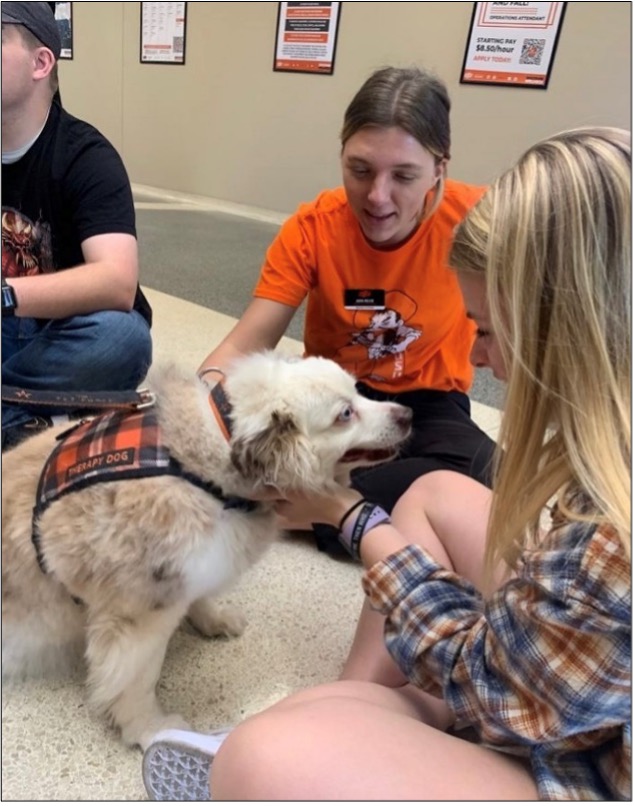
After the introduction of COVID-19 to the student population, the university seemed to realize that the students were under an unprecedented amount of stress in addition to the isolation, and they began to really focus on mental health and well-being. One program called Pete’s Pet Posse grew significantly following the start of COVID-19. Pete’s Pet Posse is a pet therapy program where students and faculty can interact with dogs all over campus. This program was established in 2013 with only eight dogs, but today there are over sixty dog teams. The program has had such an impact on campus, that in fall of 2022, they are expecting to open a building focused on this program. During COVID, Pete’s Pet Posse continued to hold dog meetings online because many students were isolated from friends and family. Following COVID, many students still feel the stress and loneliness in the aftermath of the pandemic. The university continues to make accommodations and add to their pet therapy program. The OSU pet therapy program is very popular among the student population, and people all over campus enjoy seeing the dogs. Pete’s Pet Posse also keeps up an active profile on social media platforms such as Instagram and Facebook. They post updates about where they will be bringing the dogs so as many people as possible can get a chance to see them. They also post pictures of students hanging out with the dogs at various locations. The account posted a picture of several people with one of their dogs (see figure 1).
Aside from the pet therapy program, Oklahoma State University offers a wide variety of counseling services to students. For example, they have a Student Counseling Center, an Alcohol and Substance Abuse Center, a Grand Lake Mental Health Center, a Center for Family Services, a Psychological Services Center, and the Counseling/Counseling Psychology Clinic. Each program is designed to help all kinds of people suffering from different problems they need help with. Some of these programs target students, faculty, or families. These also include both virtual and in-person, as well as walk-in or by appointment. On the website, their focus seems to be accessibility for all people. Besides counseling services, they also have hotlines on their website, in case you have an emergency that cannot wait for an appointment with the counseling services. Their hotlines include Student Assistance by Mercy (SAM), OSU Police, OSU Sexual Assault Advocates, Wings of Hope Crisis Line, the National Suicide Prevention Lifeline, and the 24/7 Crisis Line.
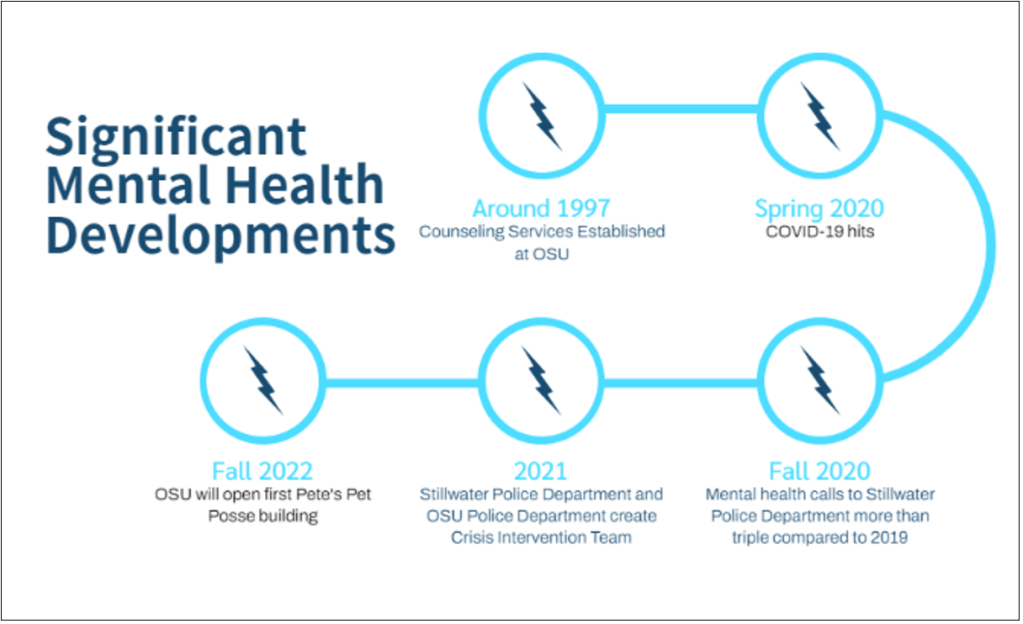
Despite all these programs intended to help students and faculty, more people than ever are suffering from poor mental health, anxiety, and suicidal thoughts. The Stillwater Police Department reported that they have had to respond to many more calls concerning suicide than in years past. Compared to reports from 2019, in 2020 the calls about mental health more than tripled, calls threatening suicide increased by fifteen, and actual suicide attempts increased by thirteen (SPD Respond). This increase of emergency calls regarding mental health crises is alarming for not only the Stillwater Police Department, but also for the university. The stress put on students increased significantly following the start of COVID, and students had to worry about doing schoolwork virtually, being isolated from family and friends, and a polarized political climate. As The Stillwater News Press announced in the Article “Two Local Officers Selected for New Mental Health Unit,” mental health had gotten so bad on campus that the Stillwater Police Department announced they were going to merge forces with the Oklahoma State Police Department to create a Crisis Intervention Team (see table 1), also called the CIT, in 2020. While it took almost a year to get the grants, the program officially launched in early 2021 (SPD Officers). This program is designed to respond to suicide calls in the area, and the officers that respond to the calls have iPads that will connect to a therapist from Grand Lake Mental Health. This task force wants to ensure that they not only help that person in that moment, but also to help them deal with their problems. While it is good that the Stillwater Police Department and the Oklahoma State Police Department are making efforts to improve their response to emergency mental health calls, the university needs to reevaluate what they can do to improve mental health within its student population. There does need to be a solid response system in place, but the university also needs to improve its counseling services and focus on suicide prevention.
Because many students are suffering from poor mental health, many of them turn to the university counseling services. While some people have positive experiences, many students do not have a good experience and end up worse than when they started. In an interview, a student details their experience just trying to get in to see a counselor:
When I originally called OSU counseling services, I was desperate and in immediate need of help and people who would support me. However, they told me that they would try and do an initial intake appointment, but after that it would be around 9 months until they could get me in, even though I explained my situation and how it required my immediate help. During the initial intake, they continuously questioned me and asked why I thought my situation was important enough to warrant a call to them. After continuously trying to explain my situation, they continuously told me my situation was not a big deal and that they did not see why I needed immediate help.
Anonymous Student
No student should be told that what they are going through is not important enough to see a counselor, and many students say they have had a similar experience. The same student said they almost did not even try to see a counselor because “[they] had several initial hesitations about going to OSU counseling services because [they] had heard so many less than stellar reviews regarding not only the staff’s actions but how they talked to their patients.” Following the initial intake, this student did not hear anything from anyone in the counseling services for months. The student goes on to describe the moment they finally heard back months later:
Several months after my initial intake (around 4-5 months), I received a call saying they had a random cancellation and told me they could get me in, but because of how they talked to me and dismissed my request for help, I told them I would not be coming back to OSU counseling services, and I found a counselor elsewhere that listened to my situation and understood why I need help.
Anonymous Student
A student should not have to beg the counselors to listen to them and give them the help they need. They were aware that this student was in a bad place, but the counseling services left the student to deal with their issue by themselves for months. Another important voice in the conversation is Oklahoma State University psychology professor, Pierce Marks. He sent an open letter on November 6, 2020 to the university at the peak of COVID. In his letter, he detailed many concerns he had about the state of the counseling services offered for students and urged the university to work to improve their services. In the letter, he gave a few of his own students as examples of people who tried to access the university mental health resources, and they had negative experiences. The first student he mentioned was suicidal and had a hard time getting in to even see the university counselors. It is important that Marks brought this up in his letter because in high-risk situations, students must have a way to get the help they need quickly and thoroughly. Another of his students recently had a friend that was murdered. When he went in to get grief counseling, they told him he could not be seen by someone for two weeks, and they left him standing there. When he did finally get in to be seen, his counselor double scheduled over his next appointment and quit responding any time he tried to reach out. This student says,
“We as students are struggling and when we ask for help, we’re told to ‘wait’ or are given inadequate resources that only serve to ruin our mental health further.”
Marks’s main complaint seemed to be the waiting time to get in to see the counselor, and this seems to be due more to counselor overload than to the laziness of the counselors themselves. Marks points out that the ratio of counselors to students is one counselor for every 1,093 students. While a counselor is not likely to have that many patients at one time, they are still in charge of too many students to help as well as they possibly could. In a study, “76.6 percent of college counseling directors reported that they had to reduce the number of visits for non-crisis patients to cope with the increasing overall number of clients” (Rakow). Because of this overload of counselors, it is very understandable that a student can have difficulty getting in and that they feel ignored. With so many students to oversee, counselors are incapable of helping anyone to the extent they deserve. Because all the counselors are so overbooked, it is the students that suffer the consequences. Aside from the problems of getting waitlisted for basic counseling needs, many university-hired counselors are not equipped to manage the problems that these students go to them for. Nationwide, other universities are having similar problems, and a country-wide conversation has begun about what can be done to fix the mental health crisis.
As the COVID-19 crisis nears the end, an important question must be considered: should universities keep focusing on mental health, even after the stressor of the pandemic is gone? While the pandemic has been a time of unprecedented stress, isolation, and depression, the topic of poor mental health is not a new worry within collegiate institutions. The Center for Collegiate Mental Health (CCMH) reported “a small but persistent increase in students’ self-reported depression, generalized anxiety, social anxiety, and academic stress over the past six years” (Rakow). Universities need to keep making strides to help their students and take efforts to make their services more helpful and accessible. Other factors besides COVID have also influenced the mental health crisis, and while COVID may be on its way out, mental health problems will continue to increase. A study done at UCLA has shown that depression, anxiety, and suicidal thoughts in college students has doubled in the last decade (Hartocollis). Since mental health has been on the decline for so long, COVID cannot be the only source to blame; another reason for decreasing mental health within college students is social media and the internet. While COVID has intensified many students’ stresses, changes have been needing to happen for a long time, and the pandemic served as a wake-up call for these institutions. As things continue to get worse for these college students, it is very important that universities across the country listen to different experiences of students who try to access mental health resources, and they need to try to make changes accordingly. Another factor for the overload of people seeking help from mental health services is the decreased stigma surrounding therapy. While there is still a stigma today, many people, especially younger people, are fighting back against stigma and are being more accepting of therapy and other mental health resources. In a study done on random college students about stigma in mental health services, one of the college students admits that while there is still a stigma, “People talk about it a lot more than they used to” (Burbage). As the stigma around getting counseling goes down, more and more students are seeking counseling.
As for what specific changes need to be made to improve the counseling services of Oklahoma State University, I do not have an exact answer on what should be done. There is no one correct solution that would solve all the mental health problems of the student body, and no matter how many changes they make, students will continue to have mental health struggles. However, the university still has an obligation to its students to provide a safe space where they can go to get the help they need. Oklahoma State University needs to try to make different changes until students are not made to feel like they are unimportant or a burden. Too many students have negative experiences with the counseling services, and they get told to wait because their problems are not urgent enough to get immediate help. If the university listens to what the student body has to say about their experiences, they can ensure that counselors can be better equipped to handle the mental health struggles of students. Oklahoma State could try adding more counselors so there is not the issue of being overbooked. However, adding counselors is not as easy of a solution as it may appear.
To be effective, the counseling services would need to hire several new counselors, but this would also require more office space and funds to pay them. Until Oklahoma State is equipped to handle more employees, one option that OSU can investigate is pop-up therapy. Other schools across the nation, such as Columbia, are offering students an opportunity to get walk in help. Pop-up therapy is when licensed professionals come to campus and students can walk right up and immediately get the help they need. While OSU would have to figure out who would be paying the pop-up therapists, this is one option that they could investigate to get students the immediate help they need. Unfortunately, it is by trial and error that the counseling services can figure out what it is that will work best for the students, and students will be the ones to suffer until Oklahoma State University can fix the problems in their system.
Works Cited
Anonymous. Personal interview. 17 March 2022.
Burbage, Michelle, and Rebecca A Vidourek. “Positive Mental Health and Mental Health Stigma: A Qualitative Study Assessing Student Attitudes.” Mental Health & Prevention, vol. 13, Mar. 2019, pp. 1–6., https://doi.org/https://doi.org/10.1016/j.mhp.2018.11.006.
Douglas/KFOR, Kaylee. “OSU Pete’s Pet Posse Takes Therapy Virtual during Coronavirus Pandemic.” KFOR.com Oklahoma City, KFOR.com Oklahoma City, 21 Apr. 2020, https://kfor.com/news/osu-petes-pet-posse-takes-therapy-virtual-during-coronavirus-pandemic/.
Hartocollis, Anemona. “Another Surge in the Virus Has Colleges Fearing a Mental Health Crisis.” The New York Times, The New York Times, 22 Dec. 2021, https://www.nytimes.com/2021/12/22/us/covid-college-mental-health-suicide.html.
Huffman, Ashlynd. “SPD Officers Discuss Mental Health after Responding to Suicide Threat.” Stillwater News Press, 23 Mar. 2021, https://www.stwnewspress.com/news/spd-officers-discuss-mental-health-after-responding-to-suicide-threat/article_8731e4ca-4b89-5296-b342-aa1adb95fc0a.html.
Huffman, Ashlynd. “SPD Responded to More Mental Health Calls amid Pandemic.” Stillwater News Press, 19 Aug. 2021, https://www.stwnewspress.com/news/spd-responded-to-more-mental-health-calls-amid-pandemic/article_91541ef3-a147-558d-a901-56c025096bda.html.
Huffman, Ashlynd. “Two Local Officers Selected for New Mental Health Unit.” Stillwater News Press, 31 Dec. 2020, https://www.stwnewspress.com/news/two-local-officers-selected-for-new-mental-health-unit/article_46904b7c-f5f2-53e7-aca9-ce155b53ac36.html.
“New OSU Center for PET Therapy Opening This Fall – Oklahoma State University.” New OSU Center for Pet Therapy Opening This Fall | Oklahoma State University, 23 June 2021, https://news.okstate.edu/articles/communications/2021/new-osu-center-for-pet-therapy-opening-this-fall.html.
Oklahoma, Tanner Holubar CNHI News. “Several Concerns Brought up in Open Letter to OSU” Stillwater News Press, 6 Nov. 2020, https://www.stwnewspress.com/news/several-concerns-brought-up-in-open-letter-to-osu/article_9df84784-7f97-53ad-b7a3-6e45909c17a7.html.
“OSU Is Striving to Be Healthiest Campus.” Stillwater News Press, BLOX Content Management System, 2 Nov. 2009, https://www.stwnewspress.com/news/local_news/article_17d9a304-37a7-5d4b-a331-7bdf02b269a4.html?mode=jqm.
Pete’s Pet Posse. Photo of Disco the dog. Instagram, 19 April 2022, http://www.instagram.com/p/Ccjn7K3AyB2/
Rakow, Donald A., and Gregory T. Eells. “The Mental Health Crisis on US Campuses.” Nature Rx: Improving College-Student Mental Health, Cornell University Press, 2019, pp. 4–16, http://www.jstor.org/stable/10.7591/j.ctvfc544p.5. Accessed 25 Apr. 2022.
“Therapy Dogs, Pop-Up Help, and Giveaways.” Events, Columbia University in the City of New York, https://www.columbia.edu/content/events/therapy-dogs-pop-help-and-giveaways.
“University Counseling Services Offers Healing and Hope – Oklahoma State University.” University Counseling Services Offers Healing and Hope | Oklahoma State University, 15 Apr. 2011, https://news.okstate.edu/articles/communications/2011/university-counseling-services-offers-healing-and-hope.html.

 archiveoklahoma.com