

By Kennadi Price
Spring 2022

The greatest thing in athletics in the last two decades is the Fellowship of Christian Athletes
Coach Dietzel
The Fellowship of Christian Athletes (FCA) has reached millions of people around the world. As one of the largest sports ministries, FCA has touched and transformed the lives of athletes and coaches in over 100 countries. The Fellowship’s first conference began with a rocky start. No more than 50 participants attended. After decades of growth, the FCA conference has grown nationally and internationally. FCA members have been sent around the world to establish camps and conferences. As a result, the organization has grown to have 25,000 attendees at conferences throughout the nation.
Paul Dietzel, a head football coach for Louisiana State University football, was introduced to FCA in 1958. After winning a national championship that year and later his quarterback receiving the Heisman trophy, Coach Dietzel stated, “The greatest thing in athletics in the last two decades is the Fellowship of Christian Athletes” (Dunn, 1980, p.84). Since 1954, The Fellowship of Christians Athletes has developed into one of the most significant sports ministries worldwide, and it all started in Stillwater, Oklahoma.
Unfortunately, this isn’t a very well-known fact. Less than fifty percent of Oklahoma State’s FCA members know that the FCA organization began in Stillwater. Although this is shocking, the organization’s impact on Stillwater is notable. After taking a survey, over fifty percent of Oklahoma State’s attendees stated that their life would not be the same without going to FCA every week and that they all attend FCA for different reasons. They stated that they had created lifelong relationships, were surrounded by competitive Christians, were kept accountable in their faith, and were given opportunities out of their comfort zone. The students also shared that they have learned various lessons at FCA that they do not think they could have found elsewhere.
There are numerous clubs and organizations at Oklahoma State University created to assist students in learning specific topics while developing as a student. Oklahoma State University has uniquely found a way to develop and help students all around the world. Fellowship of Christian Athletes was founded at Oklahoma State in 1954 and has been a growing organization worldwide since. FCA is active all over the United States and in 105 other countries. As a result of the founding of FCA, Oklahoma State has had an enormous impact on thousands of student-athletes. Many testimonies have been given at FCA by highly competitive student-athletes and professional athletes. Many student-athletes and coaches have gathered to participate in fellowship and share their common beliefs.
Doc McClanen founded the Fellowship of Christian Athletes in 1954. After serving in the Pacific in World War II, McClanen and his wife attended Oklahoma A&M- now called Oklahoma State University. While studying physical education, he felt pulled to make a difference. Doc McClanen had sparked a desire to form an organization for professional athletes to influence young adults for Christ. After reading articles and newspaper clippings about certain professional athletes, coaches, and administrators discussing their faith, he began writing them letters. Unfortunately, McClanen got few responses back. Branch Rickey, a general manager of the Pittsburgh Pirates and named “The Father of Modern Baseball,” was one of the many potential candidates who received a letter from McClanen.
McClanen believed the key to relating Christ to the athletic world would be to find those who competed on athletic fields who weren’t afraid to acknowledge their faith. His instincts told him Rickey would be perfect. Rickey and McClanen shared a common belief that men of character and worth were men who should be out of the playing field. As the years went on, McClanen was faithful to calling Rickey’s secretary but received little attention and was constantly rejected by Rickey’s secretary. However, McClanen was very determined. In August of 1954, McClanen decided he needed to speak with Rickey himself. Unfortunately, he had no money for travel. McClanen approached a banker in Wilburton who respected McClanen. Like McClanen, the banker took a leap of faith. The banker loaned him one thousand dollars, and he had to put his car up for a mortgage. McClanen left his wife and children at home and drove to Rickey’s office. In a short five-minute speech, McClanen had pitched and discussed with Rickey the importance of this foundation and all the younger athletes he was determined to help. McClanen proclaimed to Rickey that “this thing has the potential of changing the youth scene of America within a decade. It is pregnant with potential. It is just ingenious. It’s a new thing, where has it been?” (Enyeart 8 years ago, 2015). Rickey was immediately sold. He saw the potential lives they could impact. After a five-hour discussion, they composed a plan. Rickey helped acquire ten thousand dollars from a businessman. This plan was just the beginning.
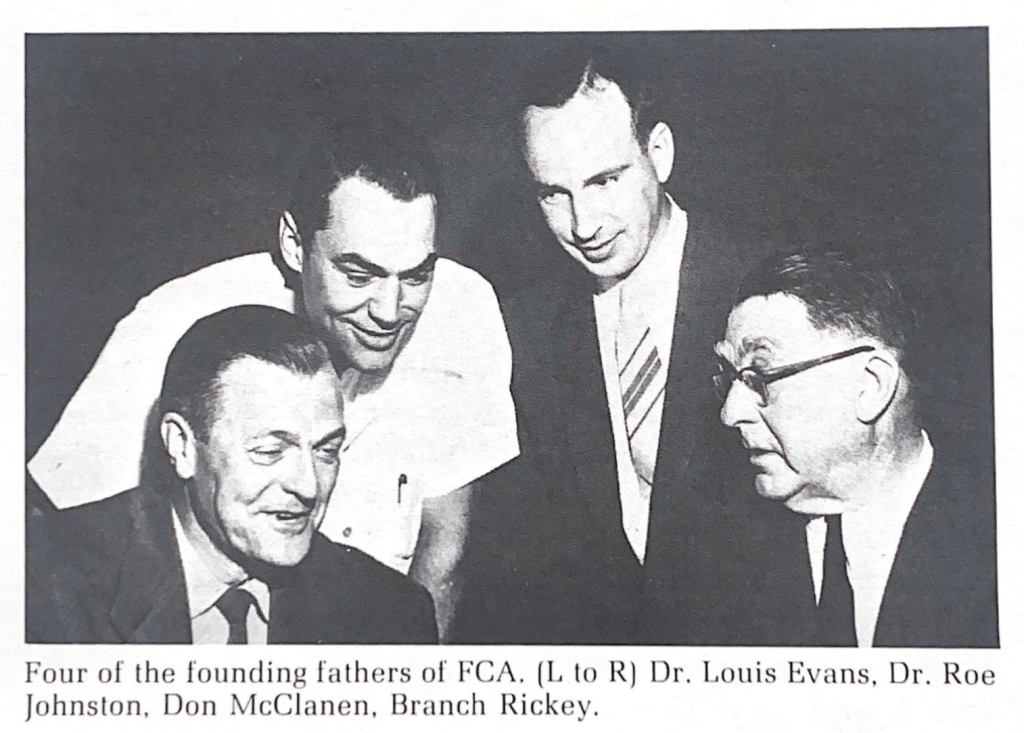
Although Rickey’s help was a good start, McClanen still struggled financially. The financial burden kept McClanen from being able to do important things like flying athletes to meet with Rickey. While trying to handle his job as a coach and look after his family, McClanen crumbled under the stress. Fortunately, McClanen’s character kept the launch of FCA going. He was able to meet with Bill Doenges, who provided him the means to gather the athletes in Pittsburg and pay off his mortgage. McClanen continued talking to large and small business owners, including the Kellog Foundation, to find more donors. With the help of Rickey, more donations were made by businessmen in Pittsburg, and FCA began rapidly growing. One crucial factor to McClanen was that the organization be founded on the ministry of Christ and nothing else. He wanted the Fellowship of Christian athletes to stand for and embrace Jesus, not athletics or the athletes involved.
After a tense meeting, it was decided that the FCA would be based on Christian ministry. McClanen said, “FCA was now a movement to present to athletes and coaches. All whom they influence. The challenge and adventure of receiving Jesus Christ as Savior and Lord, serving Him in their relationships and in the fellowship of the church” (Dunn, 1980, p.54). FCA’s intention then and now is to “make the coach’s ministry a priority conversation with emphasis on providing an environment for developing friendship, personal Christian growth, and an opportunity for involvement and leadership in FCA’s ministry” (Dunn, 1980, p.132). They would do this by channeling coaches and athletes and those they influenced into the Christian way of life and the church.
Another issue arose when some people, primarily conservative men, began criticizing the Fellowship of Christian Athletes because they felt it excluded Roman Catholics. McClanen argued that it did not. After a long debate of dedicated men, they concluded that “The Fellowship would not compete with any denominations, but it would exist to serve Christ through the church” (Dunn, 1980, p. 54).
As a testament to this statement, he asked the chaplain at Cornell University, Rich Reverend Monsignor Donald Cleary, to be on the board of directors of FCA. McClanen received a very supportive reaction from this. After being intensely involved in the Fellowship, the priest stated, “my involvement with the FCA has made me a better Catholic and a better priest” (Dunn, 1980, p. 55). Julian Dyke, an officer in FCA, stated that “we don’t care whether an athlete or coach is Catholic, Baptist, Presbyterian, Lutheran, Pentecostal, or whatever. What we hope is that through his or her participation with the Fellowship, they will become a more enthusiastic and committed churchman in his own congregation” (Dunn, 1980, p. 61). After this crisis, it was evident that this foundation “had been built on the full and open exchange of viewpoints, on sometimes heated arguments, but always on the desire to do God’s work” (Dunn, 1980, p.54) The next step was to start local conferences and eventually grow nationally and internationally.
The fellowship began to take concrete form when the State of Oklahoma issued a charter to the Fellowship of Christian Athletes on November 12, 1954. From then on, the first two conferences were key for the foundation. The very first FCA conference was hosted at Oklahoma State. McClanen organized NFL players Otto Graham and Doak Walker to visit with football players. Graham and Walker expressed their Christian beliefs, and they hoped to have an organization to carry out the work of God. Two of the college football players, Bill Kirshner and Clendon Thomas, responded with, “if Otto and Doak can come here, we can go, as Christians, to the locker rooms and assembly halls of every high school in this state” (Dunn, 1980 p. 30). The second conference, “The Kickoff for FCA” took place in Stillwater, Tulsa, and Oklahoma City in January of 1955. This conference was the first big opportunity for FCA to possibly touch countless lives. It succeeded, with 18,000 people attending across the three cities. Athletes, non-athletes, coaches, and parents turned out to meet Oklahoma State football All-American Bob Fenimore and many other well-known star athletes from across the nation. A coach who attended this conference stated that they “have searched far and wide to secure speakers who can do the job these Christian athletes did” (Dunn, 1980, p. 40).
The first national gathering occurred in Colorado in August of 1956. The founders of FCA described this conference as the one that “set the tone and pace for such future meetings” (Dunn, 1980, p. 50). Two hundred and fifty-six coaches and athletes stayed for four days in hopes of bringing together a group of men who could embrace what God was doing in their lives. This conference offered male high school and college athletes a chance to meet athletes they looked up to and admired. During those four days in the Colorado mountains, the younger athletes realized their idols were human. The college athletes present were recognized and viewed as heroes to younger athletes. They dared to tell the message that there was a greater glory than a victory in sports. One of the younger participants wrote, “I came to the conference to see my gods; I heard my gods talking about their God and, when I left, their God was my God” (Dunn, 1980, p.50).
After other well-known athletes heard this, many more decided to trade their jerseys for ministry. After years of growth, the Fellowship of Christian Athletes rapidly grew nationally and internationally. The Fellowship exploded into the national scene in 1967, with eight national conferences and over 20,000 attendees. In 2009, FCA partnered with sports ministries and established faith-based sports ministry programs in thirty countries.

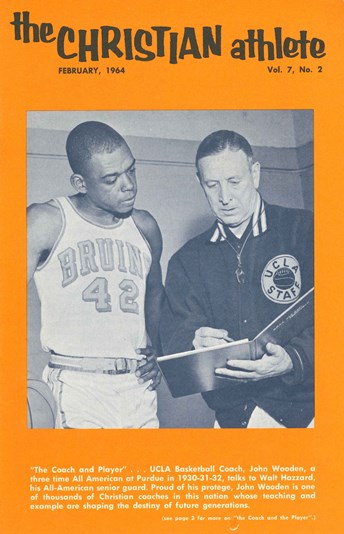
The impact FCA has had on the athletic world is very evident. Coaches have been able to dig into their players more and be more involved with their athletes as people, not just through practice and games. A collection of collegiate coaches such as Bill Battle and Ken Hayes testified that they were able to produce athletes with richer and fuller Christian lives because of FCA. Coaches provided coaching advice and spiritual leadership to their athletes because of the common ground FCA created. John Wooden, a ten-time national champion at UCLA, coached basketball for over seventy-five years. Wooden was a “loyal and enthusiastic supporter of FCA since its beginning” (Wooden, 2014, p. 14). He expressed FCA’s impact when he said, “you’ll be no saint after leaving an FCA conference, but you’ll be a better person than you were” (Dunn, 1080, p.95). The Fellowship of Christian Athletes published a devotional book telling 39 different stories by men and women from all walks of life who were personally impacted by Wooden on their faith and athletics.
you’ll be no saint after leaving an FCA conference, but you’ll be a better person than you were.
John Wooden
The Fellowship of Christian athletes has administered coaches by allowing coaches to have fellowship with one another. An annual coaches conference was launched in 1968. Coaches who have the desire to “live out the Kingdom of God in every aspect of their lives” (FCA, 2022) attend to encourage one another and attend clinics. One clinic was led by Grant Teaff, head coach of Baylor football. The clinic focused on having an open-door policy, interviews with each player, and helped to entertain black and white players and their wives at home. Plus, the importance of team devotionals before each game and daily staff devotionals” (Dunn, 1980, p.93).
One of the country’s youngest, most successful coaches and head Tennessee football coach at the time, Bill Gator expressed how much the conference meant to him. Many athletes involved have eventually joined the FCA staff. Mark Julian, assistant football coach at West Texas State University, was impacted by FCA in college as a Texas Tech Football player and later joined. Shane Williamson, current President of FCA, attended FCA while playing football at Wofford College.
Along with FCA changing the relationships between coaches and their athletes, Mark Julian testified that FCA had changed the relationship between him and his sport. Mark was playing football for Texas Tech and had had an impressive junior season. Going into his last season, he leaned on Colossians 3:23, a verse told to him by an FCA leader. This verse reads, “And whatever you do, do it heartily, as to the Lord and not unto men.” Mark said the beginning of his season was very disappointing, but he was able to shake it off and continue to give it his best because he had peace that he was on the field to give the glory to God.
The Fellowship of Christian Athletes did not start to fixate its attention on female athletes and coaches until 1974. The first women’s conference was held in Indiana in 1974. There were 28 national conferences held that year with over 10,000 total women participants. In the 1970s, women’s sports started to get more attention, and the FCA conferences increased awareness. Cindy Smith was hired to represent women on the Fellowship’s board of directors. Former FCA staff Debbie Wall stated, “In my opinion, the women’s ministry is not their equal rights or women’s lib. It’s there out of our desire for young ladies to be presented with the Gospel and to grow in Christ (FCA, 2014).” Today, over 50% of FCA members are females. The Fellowship also hosts conferences for coaches and athletes, and a specific conference for coaches’ wives. The conference for the coaches’ wives has an average of 12,000 attendees.
As the organization has grown, FCA started to receive an abundance of donations. For example, in 2011, the organization received 43 million dollars. In 2021, 180 million dollars was donated. With the help of donors and members, it is very evident that FCA is growing fast. The Fellowship started to focus on reaching more people around the world of different ethnicities, cultures, and races. Dan Britton, FCA Vice President of International Ministry and Training, stated, “What God has been doing through people in the United States these 60 years is incredible. We’ve got tremendous growth of 4 percent of the world’s population. Let’s see how we can serve the other 96 percent. That’s the journey we’re on. “This is when FCA leaped into college scholarships, awards, and service projects worldwide. FCA chapters offer college scholarships to FCA members for varying amounts (Carpenter).” FCA has also recently sent a team to multiple parts of Ukraine to not only coach and speak to children but to simply care for them during the war.
References
Carpenter, Barbie. Fellowship of Christian Athletes Scholarships. Sapling. https://www.sapling.com/8004793/fellowship-christian-athletes-scholarships
Dunn, Joseph. (1980). Sharing the Victory: The Twenty-five years of the Fellowship of Christian Athletes. Fellowship of Christian Athletes.
FCA. (2016, April 29). FCA’s Founding Father. https://www.fca.org/magazine-story/2016/04/29/fcas-founding-father
FCA. (2022). 360 Coach. https://360coach.fca.org/
FCA. (2014, May 21). Changing faces. Fellowship of Christian Athletes Timeline.https://timeline.fca.org/changing-faces/
FCA. (2014, October 31). To all the nations. FCA Magazine. https://www.fca.org/fca-in-action/2014/10/31/to-all-the-nations
FCA. (2022). FCA Annual Report. Retrieved May 2, 2022, from https://www.fca.org/docs/default-source/default-document-library/fca_financial_summar y_2021_final.pdf
FCA. (2011). FCA Annual Report. Retrieved May 2, 2022, from https://www.fca.org/docs/default-source/default-document-library/About/Financials/2011 FinancialSummaryReport.pdf
McClanen, Doc. (2010). The Birthing of FCA- Doc McClanen. fca.org. https://timeline.fca.org/founding-fathers/
Wooden, John. (2014). The Greatest Coach Ever: Timeless Wisdom and Insight of John Wooden. Revel.

 archiveoklahoma.com