
Fall 2019

Government Opposition to the Left at OSU
By Joshua Butler

The United States of the 1960s was one of political turmoil, during which the youth of America became much more active in politics. New political groups and figures emerged out of countercultural movements, many of which were deemed “radical” by the U.S. government. The government was often on shaky terms with these groups, and their treatment of these groups was of dubious morality. These youth movements were growing around the country, most predominantly on college campuses. Wherever these movements were found, the Federal Bureau of Investigation followed close behind, gathering information on these organizations and, on occasion, enacting counterintelligence operations to put them down. Oklahoma State University, like many other universities, had its own brush with the “New Left,” as these new factions came to be called. Two examples of this contact are the the visit of Abbie Hoffman, a co-founder of the Youth International Party, and the OSU chapter of Students for a Democratic Society. These examples display the political tensions of the time in the forms of the government’s lack of respect for the supposedly American ideal of freedom of speech and the protests of students who opposed their actions.

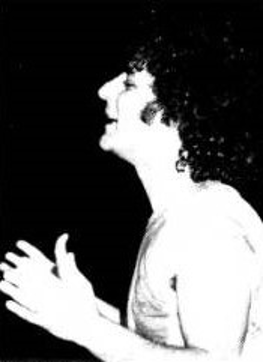
Abbie Hoffman was a major figure in 1960s youth political movements, being a co-founder of the Youth International Party, whose members were commonly known as “Yippies” (Whitfield). Author of such works as Revolution for the Hell of It and Steal This Book, Abbie Hoffman had a habit of making a spectacle of himself. In 1968 he wore an American flag shirt on the day he was set to attend an HUAC (House Un-American Activities Committee) because he knew the act would get him arrested and make the news (Raskin, 178). He was right, and became the first person to be arrested for desecrating the American Flag under a new federal statute (Raskin, 178). The next year, 1969, Hoffman was one of the defendants in the Chicago Seven trial, in which he was charged with criminal conspiracy and for inciting a riot (Whitfield). This was due to his involvement in the protests at the Democratic National Convention the previous year. The Federal Bureau of Investigation took notice of his rebellious actions, as can be seen in his rather extensive F.B.I. file. Hoffman had multiple run-ins with the F.B.I. and was often trailed by their agents, the details of which can be found in his file.

In 1971, Abbie Hoffman spoke at Oklahoma State University. He was originally scheduled to speak the previous year, but was prohibited from doing so by the Oklahoma State speaker’s committee because Hoffman’s appearance would be against the regent’s speaker’s policy. This led the University’s Student Association to go to federal court to prevent the university from invoking Oklahoma’s “Speaker Ban Bill” (Murphy, 292). The bill was the basis of the regent’s policy, and the students filed a suit with the claim that the law violated the First and Fourteenth Amendments to the Constitution (Johnson). The suit gained unanimous support from the Student Senate, and several students began working to raise funds for the cause. The minimum required was $1,500, but there was a possibility that they would require $18,000 (Murphy, 292). In the following summer, both sides began to prepare for the court case. The students met resistance from the university in their statement that students found to be interfering with normal educational programs would be dismissed, and from the state legislature in a new bill on campus rioting (Murphy, 292). OSU’s president, Dr. Robert B. Kamm, sent a letter to parents assuring them that order was being maintained and telling them to encourage their children not to participate in the recent uproar (Murphy, 293). The situation was reported on by local newspapers, some of which berated the students. The public was polarized. Some naysayers felt so strongly as to send the students angry or threatening letters, calling them immature or entitled (Johnson).
In a surprising turn of events, before the students’ case was even heard in court, a new speaker policy was approved under which Hoffman would be allowed to speak (Johnson). The case was dropped. On April 28, 1971, Abbie Hoffman spoke before a crowd of 2,500 students in OSU’s Gallagher Hall (Hoffman). His speech was rather erratic, but his charisma and wit carried him as he garnered applause and laughter from the crowd throughout (Hoffman). Hoffman asserted that FBI agents had followed him on the plane to Oklahoma. His FBI file agrees. In fact, according to a memo from the Oklahoma City FBI office, Hoffman’s original ban was due to information given to the university by the FBI (Students). Hoffman praised the students of Oklahoma State University for their breakthrough in freedom of speech, claiming that some other states would not allow him to speak (Hoffman). He criticized the United States’ policies in the Vietnam War, and encouraged students to go to Washington, D.C. for the upcoming May Day protests (Hoffman). Hoffman declared that they would march into the FBI headquarters and “take a lot of pictures” of Director J. Edgar Hoover (Hoffman). Hoffman’s speech seemed to be a good sign for those students who resisted the unconstitutional actions of the state. However, students were unsure how long their success would last, as the university’s administration still seemed unhappy with Hoffman’s appearance. But the later appearances of other radical speakers, including Jerry Rubin, another member of the “Chicago Seven,” proved that the students would retain their victory (Johnson). Despite the anti-free speech actions of the university and the Federal Bureau of Investigation, students were able to defend their constitutional rights.
Hoffman’s speech seemed to be a good sign for those students who resisted the unconstitutional actions of the state. However, students were unsure how long their success would last, as the university’s administration still seemed unhappy with Hoffman’s appearance. But the later appearances of other radical speakers, including Jerry Rubin, another member of the “Chicago Seven,” proved that the students would retain their victory (Johnson). Despite the anti-free speech actions of the university and the Federal Bureau of Investigation, students were able to defend their constitutional rights.
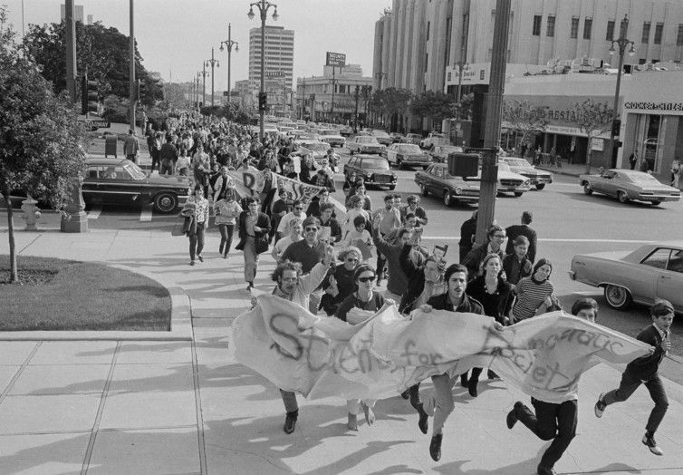
Students for a Democratic Society was another major element in 1960s political movements. Founded in 1959, the organization held its first convention in 1962 in Port Huron, where they adopted a manifesto, the “Port Huron Statement” (Gitlin). The leading concept in the founding of the group was participatory democracy, and as the 1960s progressed their popularity rose. The Vietnam War caused a spike in their memberships, and they became widely known as an anti-war movement. Unfortunately for SDS, growing factionalism meant that by the end of the Vietnam War the society was no more. While OSU students may not be surprised to learn that their university was home to a chapter of SDS, they may be shocked to learn that the chapter was dismantled through counterintelligence operations enacted by the Federal Bureau of Investigation. This rather extreme act by a powerful government agency was unfortunately not uncommon in this era.
In 1968, OSU’s chapter of the SDS was newly formed (there had been a previous SDS chapter that had dissolved) and only consisted of a few members. The University of Oklahoma’s chapter, while larger than OSU’s, was still relatively small. In the FBI file on Oklahoma City’s COINTELPRO against the New Left, a letter from the Oklahoma City FBI office sent to the office of FBI Director J. Edgar Hoover on September 30, 1968, states that the division had not taken nor had plans to take counterintelligence action against New Left activity. This was due to their being seemingly little threat seen in the small New Left organizations in the area. After a sternly worded memo was received in return, the office set to work in dismantling what little New Left activity there was to be found.
The COINTELPRO file goes on to show the tactics used by the FBI to take down the SDS chapter at OSU. One tactic they utilized involved tipping off local authorities to drug use by certain members, bringing about their expulsion. Another strategy was sending a letter to the father of one of the members, untruthfully claiming to be a fellow OSU parent, and warning them about the dangers of the SDS. The student did not participate in SDS the next semester. The FBI also successfully spread distrust among the members to the point that they refused to associate with a student who had been one of the most radical members. In a letter to the director of the FBI, the Oklahoma City office had this to say:

The authoritarian actions of the Federal Bureau of Investigation put an end to the relatively small Oklahoma State University chapter of the Students for a Democratic Society. The SDS was not re-established on campus. The FBI was triumphant in their attack on freedom of speech.
These stories may not both have bad endings, but they both display something about the government of their era. The government’s disregard for the rights of Americans was a travesty. Whether it was the state legislature or the FBI, the American government was not on the side of its citizens. Because the political views of a person or group was outside the norm, they were ignored or put down. These events should be seen as travesties that we should strive to avoid in the present and future. Because of events like these, government authority should never be left unquestioned.
Works Cited
“Abbie Hoffman.” FBI file for Abbie Hoffman, part 15, document no.100-449923, 21 Oct. 1971. The FBI: Federal Bureau of Investigation, US Department of Justice (link)
Hoffman, Abbie. “Abbie Hoffman at OSU talk–Tape 1.” April 28, 1971. Lee Agnew Collection, Oklahoma State University Archives. (link)
Gitlin, Todd. “What Was the Protest Group Students for a Democratic Society? Five Questions Answered.” Smithsonian, May 2017. (link)
Johnson, Erica. “Abbie Hoffman Visits Oklahoma State University in 1971.” The Chronicles of Oklahoma, p. 14.
Murphy, Patrick M. “History of Oklahoma State University Student Life and Services.” Oklahoma State University, 1988. (link)
“New Left – Oklahoma City.” FBI file for Oklahoma City New Left COINTELPRO, document no. 100-449698-35, 10 Oct. 1970. The FBI: Federal Bureau of Investigation, US Department of Justice. (link)
Raskin, Jonah. For the Hell of It: The Life and Times of Abbie Hoffman. University of California Press, 1996. EBSCOhost. (link)
 archiveoklahoma.com