
Bailey Hendershott
Fall 2023
Universities across the United States offer many different mental health and physical health services for the numerous different things students will encounter while in their education careers at their institutions. However, one department the vast majority of campuses are lacking in is Alcohol Abuse help resources, despite it being a growing problem across the country. It is estimated that 1,519 college students (aged 18-24) die every year from alcohol-related injuries, and around 696,000 assaults happen while one or more party is under the influence (collegedrinkingprevention.gov). While there is a level of personal choice to these statistics, it does raise the question, of why are there not more readily available alcohol resources on campus at every university, specifically alcoholics anonymous, despite 13% of full-time college students qualifying for an alcohol use disorder (collegedrinkingprevention.gov, 2021)?
The statistics of alcohol abuse that will be, and have been discussed alone are worrying, but the main building block of this paper will be the student interviews featured inside. As I went about my research, I interviewed several students at Oklahoma State University who anonymously opened up about their struggles with alcohol abuse related to school, and their desires to become sober, but the lack of support to reach out they feel from their peers and staff at Oklahoma State University. These interviews will be anonymous as that is how they felt comfortable talking to me about such a sensitive and personal topic.
In America, there is a rhetoric of the ‘struggle grind’ or ‘grind mindset’ which is the belief that to be successful you have to struggle. If you want to make money or have a good family life or career, then you have to constantly struggle and constantly stress, because if you stop you fail. This is a toxic and dangerous mindset, and I have found this mindset is also extremely common in the undergraduate culture of a college career. There is stress and anxiety in so many areas in college including social life, classes, loneliness, and new responsibilities. There is a common understanding that college students are supposed to be mentally tired, sleepy, and constantly working but this is a simply unhealthy and sad way of life that so many students are forced to endure because it is ‘normal’.
This “grind culture” seems to be a quintessential part of the college experience. You almost feel left out when you’re not a part of it. We have created a sense of false urgency, where it feels like we need to be constantly working and pushing ourselves in order to be productive. (Duke, 2023)
This mindset in college students results in an onslaught of the stress of not performing well enough to meet the standards for this way of thinking. “Stress has long been known to increase vulnerability to addiction. The last decade has led to a dramatic increase in understanding the underlying mechanisms for this association (Sinha, 2008).” this stress caused by school and the need to succeed, can lead to alcohol and drug abuse in students. It has also been studied that when a student starts to drink to manage stress, they increase the quantity and frequency of their alcohol consumption. This can lead to missing class, and missing deadlines, Which leads to more stress., and more drinking. A Penn State study found that out of 744 students who they monitored over three years, students over the three years drank more volume and frequency of alcohol when they were stressed from school. (Russell, Almeida, Maggs, 2017)
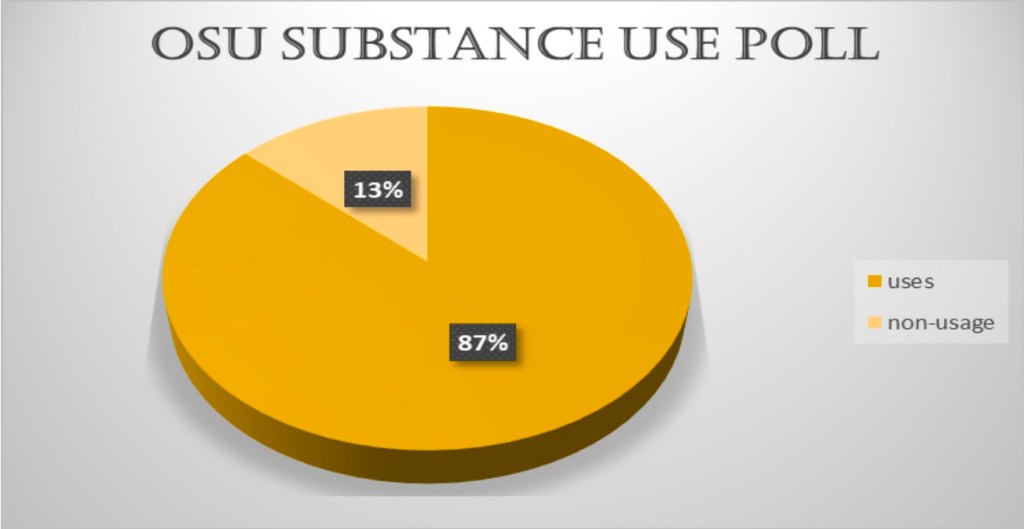
As I researched the topic of alcohol abuse on campus, I conducted a poll based on stress-correlated alcohol usage for the students of the Oklahoma State University class of 2026 platform which has 1,634 users. In this poll, 463 students participated. These were the results. Out of 463 students, 401 (86.8%) said they regularly use alcohol, or other substances as a school-stress management mechanism. While only 62 (13.2%) students said they do not use substances for stress. When looking at this, though it is a small portion of the OSU student body that responded to the poll, it is an alarming statistic for the students who did respond to the poll (Anonymous Student Poll, 2023). These are students who admit to school work being a root cause of their using alcohol to cope which is a very troubling thing to hear from students who are on average 19-20 on this platform.
What resources does Oklahoma State University provide for alcohol or substance abuse issues? Well, when you search for “Alcohol” on the school’s website the first two links available are called “Alcohol and Tobacco” and “Alcohol and Drug Awareness”. The first of which is simply a list of places where you can and cannot use alcohol and tobacco on campus and the punishment if you are caught with it on campus. The second link is a list of Oklahoma Laws that a student caught with alcohol or drugs can be faced with, including:
Since July 1, 2000, students who are convicted of an offense involving the sale or possession of a controlled substance may become ineligible for federal student aid. For the university‘s complete drug and alcohol policy regarding the Drug-Free School and Communities Act, request the Oklahoma State University Student Rights and Responsibilities Governing Student Behavior, Oklahoma State University Drug and Alcohol Policy, or the OSU Dangers of Drugs and Alcohol Abuse pamphlets. (Oklahoma State University, 2023)
As you scroll on the search for “alcohol” on the school website after the top two links which just detail the punishments for students who are caught on campus with alcohol or drugs. Including the risk of losing their financial aid, which for many students is the only way they can be in school. This is important to note because OSU does have an alcohol and substance abuse center, located with the office er mental health and wellness resources, however, to find this you have to go through seven different links which are titled similarly, detailing how to practice safe use of alcohol, the punishments you can receive, and the policies. When you look at the official handbook as well, out of twenty-nine pages about alcohol abuse, four of them are about the recourses available to students, two of the four pages being resources in Stillwater Oklahoma not at OSU, while twenty-five of them are about the punishments of students caught drinking or doing drugs.
This raises the question of why OSU does not promote this to the students, as before my research I had never heard of this resource, but I had to look through seven links to find it. So after discovering this resource, I went back to the anonymous students whom I interviewed, and I asked the students if, when they read through the first two links, they would continue to look for more information, to which I got the common response of “no”. Another issue the students I interviewed had issues with was paying for alcohol treatment. When I asked why they explained that they were scared of their parents being able to see their Bursar account as they are helping pay for their school, so they have proxy access to their account, and they simply do not have the spare money for sessions regularly as a student.
In one of my interviews, it features a 18-year-old girl, who’s a freshman at Oklahoma State University. she talked to me about her opinion on the alcohol and drug abuse center costing money. “It’s a struggle, to make money in college, I feel like I wouldn’t even be able to afford the center. and I definitely wouldn’t want my parents to see me charge it to my Bursar account. It kind of rubs me the wrong way, that I have to pay for something when I’m already paying $20,000 a year to be here. but they want me to pay more money, for a counseling service I already pay a fee for? That makes me angry.” (Anonymous student #3)
In another interview, I talked with a nineteen-year-old male sophomore who opened up about his struggles with alcohol and other substances during his time at Oklahoma State University. He talked about how he tended to drink on weekdays if he knew he had a lot of schoolwork to avoid stressing himself out “When I have a lot of schoolwork, like a lot I have gotten blacked out to avoid doing my school work. I work a job from 5-10 pm because if I don’t I can’t even be in school. But by the time I can get back to doing school work, I’m so tired and burnt out I don’t even want to touch it. So I get blacked out.” When I asked about how he felt OSU does to support students who are having these issues he responded “I don’t know. I’m not twenty-one, so I don’t even feel like I can talk to counseling about it because I’ve heard of them notifying the police.” (Anonymous Student #1, 2023).
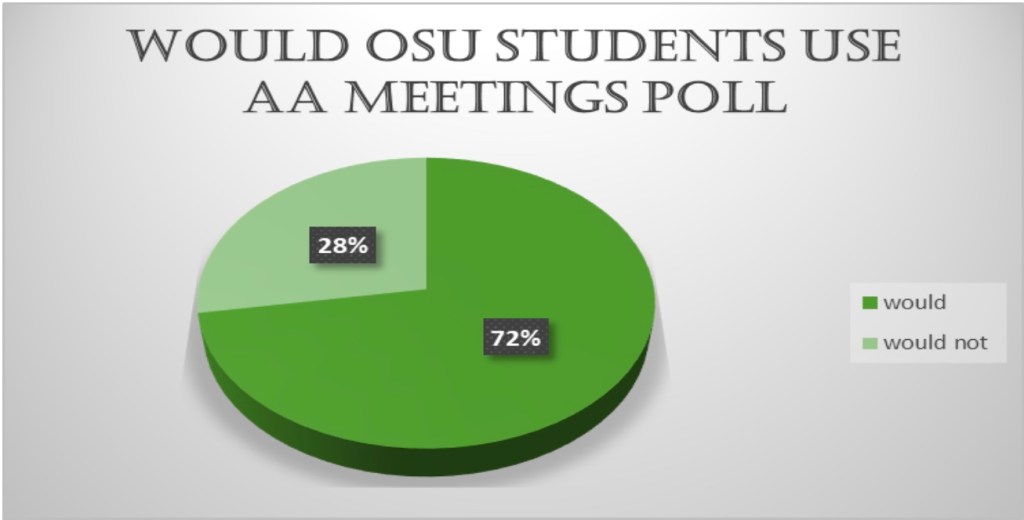
Along with the poll asking if students use alcohol as a coping mechanism, I ran another poll in which 331 students participated. This poll was based on how Oklahoma State University students would feel about real Alcoholics Anonymous meetings being offered on campus as a resource open to all students. In the poll 238 (72%) students said that they would be open to attending Alcoholics Anonymous meetings if they were offered on campus. While 93(28%) students said they would not be open to trying AA meetings (Anonymous student poll, 2023). Once again this is a staggering statistic that adds to the question of why this is not offered, but also never brought up as an option. AA is a researched and proven way of battling alcoholism, that students have shown are more receptive to than other methods. It is a method that allows people to rely on each other in an open and welcoming environment here the power isn’t sided with it being the patient vs the therapist.
We cannot discuss the idea of Alcoholics Anonymous being put on college campuses without talking about the evidence and research of the program for the general public. While AA is very commonly criticized for being unsuccessful as it has been found to average a 5-10% success rate, this success rate does not make it unsuccessful (American Addiction Centers, 2023). Even with a 5-10% success rate, with over 2 million people in AA meetings each year that would still mean it is working for 100,000-200,000 people worldwide (alcoholics anonymous, 2023). So despite the lower-than-ideal success rate, no one can just write off the hundreds of thousands of people the program does help. So what is AA? Alcoholics Anonymous is a group setting in which a group of people who wish to start the road to recovering from alcohol abuse meet together as often as a person wants, to share helpful advice, tips, and support for the other members. Its fundamental practice is the Twelve Steps in the Program which are steps to recovery through Affirmation and faith in yourself and the program. But one of the core things about AA is that it takes the power imbalance away from a therapist-patient setting, and becomes a fellowship of people trying to better themselves, which is a much more welcoming, and enjoyable environment than feeling scrutinized by a therapist over alcoholism.
In another interview, I talked with a 20-year-old sophomore girl Who opened up about her own experience of knowing people in Alcoholics Anonymous. “ I’ve known people who’ve gone through aa, specifically some family members. and for some of them, it worked well, but for others, it didn’t.” I then asked why she thought it didn’t work for some but it did for others. “ I think it was their mindset, the ones that it worked for were younger around 26 or 27, and the ones that didn’t work for were older In their 50s. I think it was because of the mindset, that the older family members had been drinking for a long time, while the younger ones had not been for as long I don’t know if that makes sense.” (Anonymous Student #2, 2023).
The cost of the alcohol and drug abuse center at Oklahoma State University is one of the most striking things that deters students from wanting to attend as the students I have interviewed told me. This is another reason I believe Alcoholics Anonymous is a very good option to partner with for Oklahoma State University as their motto on price is “It doesn’t cost anything to attend A.A. meetings. There are no age or education requirements to participate. Membership is open to anyone who wants to do something about their drinking problem.”(Alcoholics Anonymous, 2023). It is just as the name suggests “anonymous” and free.
Stress is a root cause of alcoholism in students. It’s a growing epidemic, and most of the stress comes from school. so as Oklahoma State is a land grant school, they have a greater responsibility to help the students, than most universities. Land grant Universities are research schools, that are meant to better the community, an easy place to start is with their students. listen to the students, and hear what they need. if they do not like the current drug and alcohol abuse program, make a new one. students are paying to go to a land grant school, and with the emphasis that Oklahoma State University puts on being a land grant school, with a land grant mission, they need to step up to that title and start the change that needs to happen. Start by promoting mental health and starting new on-campus ways to help students with their alcoholism. The students who I have talked to, have said that they would go to an AA meeting. so why is it not offered? it’s researched, it works, and as one interview put it the younger you start, the more likely it is to work. As a land grant school, Oklahoma State has taken the responsibility of providing these resources to the students who go to the school. The motto of land grant universities, is to teach, conduct research, and provide communities with resources. so let’s start with helping the students at the school, as a community.
Firmly rooted in this vibrant tradition — and fiercely intent on extending its impact and influence to meet this critical moment — Oklahoma State University intends to become the nation’s preeminent Land-Grant university. We are Land-Grant. (Oklahoma State University, 2023)
ORP, Substance Abuse and The Lack of Support in College Students
Alcoholism has been a growing problem in students that has been researched for decades, and I’m not sure it’ll ever stop. But we can actively make moves as a university to better the environment, and resources available. For a lot of students, all it takes is one friend to start, or one peer to start, and it opens up the door for more open conversation, around such a sensitive topic. Just because the grind mindset and alcohol culture are very prevalent in students, that doesn’t mean it has to stay that way. The students that responded to my polls, and that I interviewed, expressed a real interest in taking control again over their substance use. and admitting that is usually the hardest part of getting started. With so many land grant missions, Oklahoma State University could be one of the first universities to start an Alcoholics Anonymous program in a move that shows they care about their students, and they hear them. and if they want to be the best or only land grant school that matters, they can start with their students, and show them that they care. Because if one University starts it, and other universities see The effect and research behind it, it will start a new standard, that will help students all over the country through new programs for alcohol abuse on all campuses.
ORP, Substance Abuse and The Lack of Support in College Students
References
Alcoholics Anonymous (2023), “A.A. Around the World,” Alcoholics Anonymous.
Anonymous Student #1, personal communication, November 3, 2023.
Anonymous Student #2, personal communication, November 18, 2023.
Anonymous Student #3, personal communication, December 6, 2023.
College drinking prevention (2021), “Consequences,” College Drinking Prevention.
Duke, Bailee (2023), “Fighting ‘Grind Culture’: prioritizing wellness this finals season,” University of Michigan.
Erickson, Mandy (2020), “Alcoholics Anonymous most effective path to alcohol abstinence,” Stanford Medicine.
Forbes Council member (2020), “Eight Ways Professionals Can Ditch The Grind-Till-You-Die Mindset,” Forbes.
Hendershott, Bailey, OSU substance abuse student poll, October 2023.
Hendershott, Bailey, OSU Alcoholics Anonymous student poll, October 2023.
Oklahoma State University, (2023), Defining land grant, Defining land grant preeminence and priority | Oklahoma State University
Oklahoma State University (2023), “Alcohol and Drug Awareness,” Oklahoma State University.
Russell, M. A., Almeida, D. M., & Maggs, J. L. (2017). Stressor-related drinking and future alcohol problems among university students. Psychology of addictive behaviors: journal of the Society of Psychologists in Addictive Behaviors, 31(6), 676–687.
Sinha R. (2008). “Chronic stress, drug use, and vulnerability to addiction.” Annals of the New York Academy of Sciences, 1141, 105–130.
Wagener, Dan (2023), Alcoholics Anonymous: The 12 Steps of AA & Success Rates, American Addiction Centers, Alcoholics Anonymous: The 12 Steps of AA & Success Rates

 archiveoklahoma.com