
Jack Ray
Fall 2024
The 1800s are characterized by major historical feats that have shaped the way the world is organized in modern society presently. A majority of people think back on the 1800s as a time of unsettlement in Europe, or the Civil War of American history, however the mid-1800s brought about a time of revolution within the community of bicycle enthusiasts. The first modern bicycle was born in middle of the 19th century and from there the trend in transportation took off. With the infrastructure of the American road system not entirely paved, a majority of the roads that were available to be used for cycling were primarily dirt and gravel. The only roads that were paved were those in major city hubs such as Boston, Philadelphia, and Washington DC to name a handful (Legan, Gravel Cycling, 2017). With the pavement not being readily available to everyone, and those that had pavement, there was not a a lot to ride on. Thus, leaving the American backcountry being the best available resource to explore and put the bicycles to good use.
A group of individuals found great excitement in this new passion they had discovered and wanted to test their fervor for gears on the pavement. The League of American Bicyclist, formed in 1880, led a group effort to improve the American road conditions. Through this effort, many of the major highways that are still heavily trafficked were conceived. The efforts of the League were highly successful; however, they were not able to accomplish the goal of getting 100% of American roads paved, leaving the backcountry untouched. However, since this effort, a majority of riders have transitioned to the roads. Leaving the origins of riding a smaller held passion for an elect minority of cyclists.
The minority of cyclists who still choose to ride on the roots of gravel, have benefitted from remaining loyal to the origins of the sport. Within the past ten years, there has been a major resurgence on a national scale of riders flocking back to the backroads. There has been revival on the American streets, bringing forth a forgotten history that still has much more to give than lying dormant within the words on the pages of a history textbook.
Lurking outside the pages of a history book, in our real world, are threats that aim to forge a majority claim on the gravel market. Throughout America, corporate businesses aim to garner a monopoly over the American people. These mega-businesses are consistently searching for new ways to exploit the working class and pad the pocketbooks of the elitists and higher upper class in the country. With this plague sweeping across our nations economy, local businesses are finding ways to fight against corporate Goliaths that are seeking to take away their clientele. Scattered throughout the country, are local businesses that have found ways to keep up with the ever-changing landscape that the American business scene entails. Often classified as “hidden gems”, run by a small number of staff, the people that are behind these shops and stores have found ways to produce the highest caliber customer experience and even events put on by the people for the people.

District Bicycles, located in the heart of downtown Stillwater (Oklahoma) has created an event that rivals these giants of the industry – an elite gravel cycling race, put on by the people for the people. The race, Mid South, attracts thousands of endurance athletes to the blue-collar town of Stillwater, Oklahoma with the aim in mind of providing each and every individual the best possible experience they can imagine. Each race participant either competes in a 50 or 100 mile bike race, or for those that choose to run, there is a half-marathon or a 50 kilometer run avaliable to partake in. For those who desire more, there is the opportunity to partake in “The Double” which is a 50 kilometer run on the first day and on the second day they will embark on a 100 mile bike ride. With the diversity in events, a multitude of athletes with backgrounds in either the the biking or running disciplines come to Stillwater to test their strength on the dirt roads that encompass the town. In the past year, over 3,000 participants partook in the Mid South, coming from in-state, out of state, and even overseas (C. Wintle, Personal Interview).
Anytime travel occurs, there is then a need for accommodations to house, feed, and entertain the travelers. Over the weekend of March 15-17, 2024, Stillwater experienced a 6.7% increase in population due to the travel for Mid South (Students factored out of the population) (United States Census Bureau, 2023). With the wave of tourism that the small town experiences, other local businesses are bound to be impacted by the partnerships through the event, as well as the need for food, housing, entertainment, and shopping being factored in.
The Mid South, a local professional gravel bicycle race, creates an increase in profit-margins for the local businesses located within downtown Stillwater, through the increase in tourism. Anytime tourism increases the local population of a city by anywhere near 6.7%, businesses will profit, specifically dining and housing industries. But, what is the increase in profits that these local businesses experience? It is very apparent that these businesses will profit moreso than they already do, but to what extent do they increase their profit margins?
Bobby and Crystal Wintle, the owners and managers of District Bicycles, are the hosts of the endurance weekend. In the upcoming edition of the Mid South, March 13-16, 2025 will be highlighted by sweat, mud, and gears that are guaranteed to leave participants with an experience similar to none other. A projected number of athletes surpassing 3,000 individuals will line the streets of Stillwater to embark on their own journey, whether it be on a bike or on their feet, the masses are starting the pilgrimage to compete. After one taste of the weekend, and the experiences that come with it, it is no surprise that each year the numbers continue to swell. Interest level continues to skyrocket, as word of mouth enables cyclists and runners alike to tell of the legend that the weekend is. But, even Rome had its humble beginnings and the Mid South is no different, starting out with under 200 registrants wanting to participate.
LandRun 100 was the predecessor to the flourishing endurance weekend that is the Mid South. Its genesis had humble beginnings, which simply just consisted of a group of cyclists who desired to explore the vast amount of dirt roads that surrounded the college-town. The original namesake “Land Run” was in reference to the Oklahoma Land Run that took place in which white settlers were permitted by President Benjamin Harrison to settle in unassigned Indian Territory. Both Bobby and Crystal wanted for their event to have no barriers in terms of exclusivity, no matter the individual or their background. Riding gravel is for everyone and in this case, if a name change was in order, so be it, the name will be changed. The updated name “Mid South” is an evolution of all the ways that the event has changed and grown over the years said Bobby (B. Wintle, Personal Interview).

Mid South began as strictly a 100 mile bike race, but has slowly transitioned into an endurance festival. To outline the past year’s festivities, Thursday consisted of a packet pickup, a group ride, and the unveiling of the Mid South Pale Ale at Iron Monk. On Friday, runners checked in and raced, while there were festivities going on all throughout downtown Stillwater. Fast forward to Saturday and folks got up bright and early to race either a 100 miles ride, a 50 mile ride, or a 12 mile ride. Later that evening at around 7:00pm, the awards got passed out and the real party began. To wrap up the eventful weekend, there was brunch at StoneCloud brewery along with yoga sessions for cyclists to stretch out after a days worth of riding.
Another unique feature that no other race offers is the coveted dead-last award otherwise known as DFL. The DFL award goes to the participant that finishes last in their respective race, which is significant because then the post race party can commence. It may come as a surprise, but in recent years there has been competition to see who can finish last. Why might one do this? The winner gets a long horn skull that they are able to do with whatever they desire. Imagine that as an addition to the trophy room.
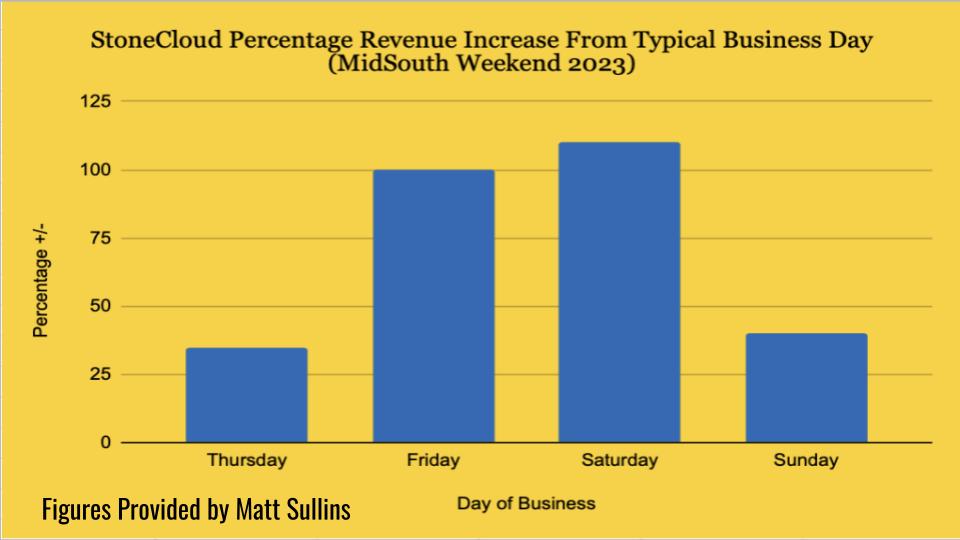
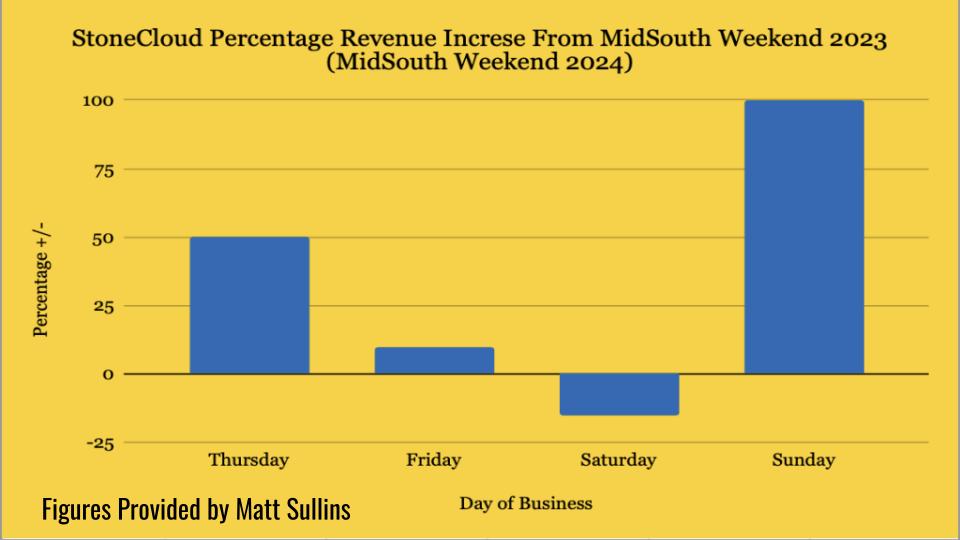
Along with the riding that is the focal point of the race, there is an opportunity for smaller businesses to showcase themselves to the endurance focused community via the expo that is sectioned all throughout downtown. The vendor expo serves as an opportunity for large and small businesses alike to show off what they have to offer. Whether it be Skratch Labs or Aspen Coffee, both alike have a service they excellently cater to their customers in and the vendor expo is a unique opportunity that Mid South is able to provide companies with. District Bicycles would not be able to put on the endurance weekend on their own to the degree that it is without the help of sponsors and partnerships. With the event bringing in so many people from across the nation and globe, it comes as no surprise that companies benefit from the increased number of visitors. Partnerships have been able to form through the relationships build amongst business owners in the downtown area. For example, Iron Monk Brewery produces the official Mid South beer each year. While Stonecloud Brewery hosts the afterparties as well as produces the official zero-alcohol beverage of the event. Out of this, it comes as no surprise when these businesses have their most profitable days ever over the four day span. This past year, Stonecloud brewery had its three most profitable days since it moved into its permanent location it currently resides in. Other businesses also had similar outcomes as well. Restaurants that have opted into being a part of the weekend also saw their most profitable days in the franchise history. Even newcomers to the downtown family such as Hatch reaped the immediate benefits of the weekend. Others that had been there for quite sometime even re-wrote the history books: Finnegans’s Pub, Zannotti’s Wine Bar, and Aspen Coffee Company, all were able to have the most profitable day in their company history (Sullins, Personal Interview). Although data sets are incomplete with the exact percentage growth that each business experiences, it is confirmed that each business experiences profits that are only seen during the Mid South weekend, rewriting the history books each year.
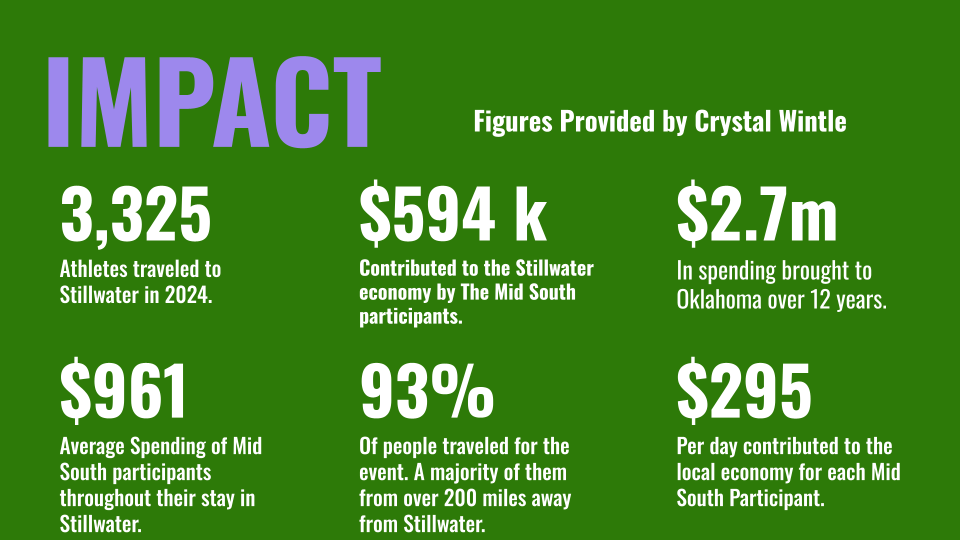
With the rapid re-writing of the history books and the pace of development each year, the question arises: What is next? What more could possibly come out of a flourishing celebration of humanity that is Mid South? Well, at the moment, the event is set right at its capacity to provide the maximum amount of people with the best time imaginable. The issue that currently stands in the way of growth moving forward is the city of Stillwater’s lack of ability to support an event that is exponentially growing the way this one is. When it comes to hosting people, three essential things are needed: Food, Shelter, and Entertainment. Furthermore, when 93% of athletes are traveling to Stillwater, a majority of them being from over 200 miles away, the amount of housing and shelter has its limits. As it stands, the city has found its functional limit in this department. If the goal for Mid South participants is to have one of the most enjoyable weekends of their lives, while doing an activity they love, then there is a need for a limiting number of entries to be placed on the event.
Until Stillwater expands enough to be able to properly host more people, there will not be another large spike in the number of participants. As for now, the focus is on controlling what is able to be controlled – the little things that marginally improve the quality of the event on a macro-scale. All that being said, there still a big dream that is circulating up in Bobby’s mind: Bringing in Red Bull.
Dreaming big and finding ways to turn dreams into reality has been a specialty of District Bicycles since its conception well over a decade ago. Their ability to craft an elite event whilst making it feel very intentional and personal is what keeps people coming back. Through that, the economic impact has translated into the growth of other businesses within the near vicinity in the downtown area. A large partner of Mid South, Stonecloud Brewery, serves as the location for post-ride drinks and vibes, which benefits both the cyclists and the business alike. Partnerships such as this one serve as the backbone for growth across the downtown business family in Stillwater. Although data sets are incomplete with the exact percentage growth that each business experiences, it is confirmed that each business experiences profits that are only seen during the Mid South weekend each year. 2025 is projected to be no different than the decade of memories and tradition that served as the foundation for the upcoming edition of Mid South. It is without a doubt that as the downtown area continues to grow and expand, new partnerships will be formed, memories will be made, and a lot more gravel will be shred on the backroads of Stillwater, Oklahoma.
Works Cited
Cotton, Jim. “Go Gravel, Go Home: Strava ‘Trent Report’ for 2023 Shows 55 Percent Growth in Gravel Riding.” Velo Outside Magazine. 3 Jan. 2024, https://velo.outsideonline.com/news/go-gravel-go-home-strava-trend-report-for-2023-shows-55-percent-growth-in-gravel-riding/. Accessed 19 November 2024.
Mid South Gravel. https://www.midsouthgravel.com. Accessed 19 November 2024.
Doucette, Cate. “The Rise of Riding Gravel”. Outdoor Sport Institute. https://www.outdoorsi.org/blog/gravel. Accessed 19 November 2024.
Hansen-Gillis, Lily. “Why the Land Run 100 changed its name to the Mid South.” Gravel Magazine. 20 May, 2020, https://cyclingmagazine.ca/gravel/why-the-land-run-100-changed-its-name-to-the-mid-south/. Accessed 21 Novemeber 2024.
Legan, Nick. “History of Gravel Cycling”. Gravel Cycling Hall of Fame. https://www.gravelcyclinghof.com/gravel-history. Accessed 19 November 2024.
Sullins, Matt. Wintle, Bobby. Personal Interview. 6 November 2024.
United States Census Bureau. Quickfacts: United States. U.S. Department of Commerce, 2023, https://www.census.gov/quickfacts/stillwatercityoklahoma. Accessed 5 November 2024.
Wintle, Crystal. Personal Interview. 14 October 2024.

 archiveoklahoma.com