
By Joshua Levick
Spring 2022
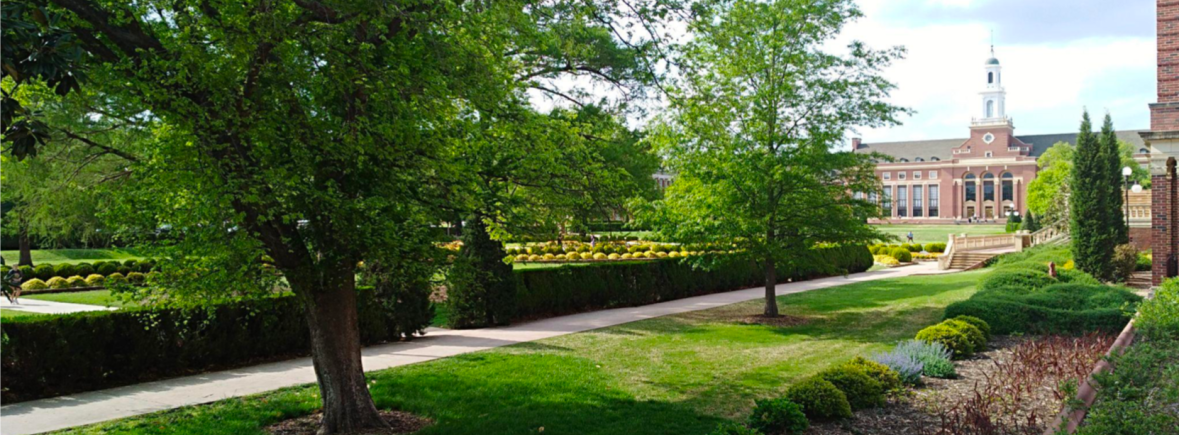
The modern day college experience is notorious for its high cost. As such, you should want as much of that money as possible to provide a better education and fuller experience. Colleges and Universities often can spend large amounts on landscaping and campus aesthetics, upwards of hundreds of thousands of dollars (in the most expensive scenarios) that could have otherwise been spent on providing better services and supplies for students. As a student of Oklahoma State University, it is easy to tell that a significant amount of effort and resources is being spent on maintaining the campus alone. These expenditures, however, are not necessarily a waste. Psychologists have done research proving the effects of the space around someone and how it impacts their mental state.
I do believe that providing a place that more people can enjoy creates many benefits. Although, costs should not be ignored over what good is created. The worth of landscaping and architecture is not always clear due to the difference of people’s perceptions, but that does not exclude it from deciding if resources spent could be used better elsewhere. Before that can be judged though, it should be made clear of where the college got the ability to pay for it in the first place.
Most colleges and universities have many different forms of income and support. From the most recent fiscal year budget summary, OSU has an estimated grand total revenue and expenditure (as a not-for-profit public university) of about 1.5 billion dollars. Of that money, less than a third of it comes from student tuition and fees with a slightly bigger return in spending for instruction and service. Shown green in the figure below, is the amount OSU has budgeted for landscaping, maintenance, and utilities. It only accounts for little more than five percent of the whole budget, but is roughly equivalent to a large sum of $80 million dollars.
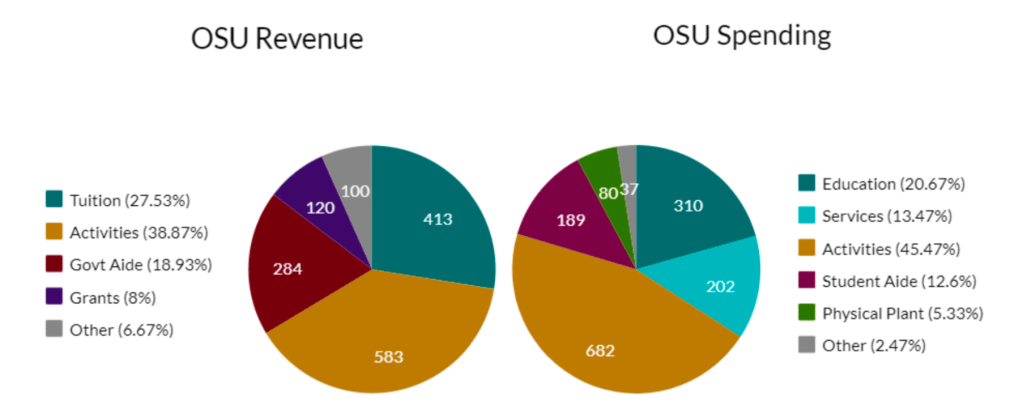
This seemingly extravagant amount goes into keeping the University’s facilities running and employing those who manage them. Expenses add up quickly with bills, material costs, and keeping workers paid. This is only exacerbated by the size of the campus and the effort put into its landscaping projects.
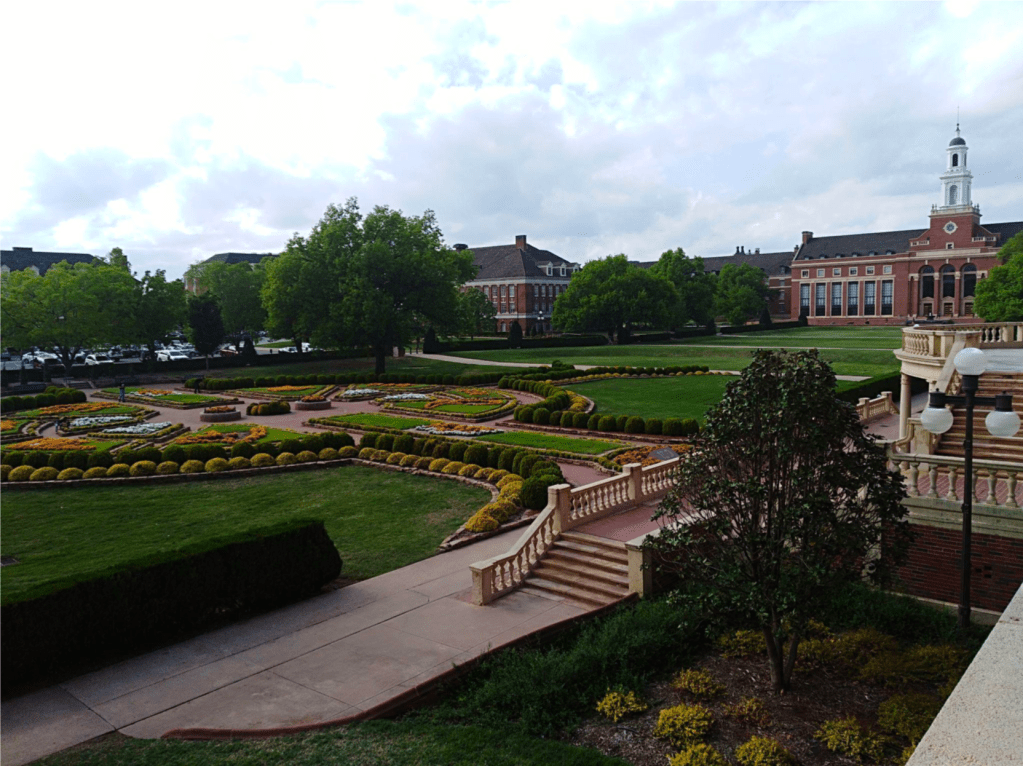
There are many more aspects to cost than just money that should be thoroughly considered. Conceptualizing space as a resource offers a prime example outside that category and is just as important to the expenses of landscaping on the college. Of the Stillwater campuses almost 1500 acres, a large amount is used for plants of many kinds. These vary from many flowers sporting OSU colors of orange and yellow and more, to trees, bushes, and other plants. All of this greenery is integrated fairly well into campus and the majority are fit between buildings and sidewalks making it much easier to appreciate. One of the most notable places on campus are the Formal Gardens south of the Edmon Low Library and Theta Pond further southwest. Its central location and its proximity to important buildings gives it plenty of foot traffic and helps people see one of the more vegetated places on campus.
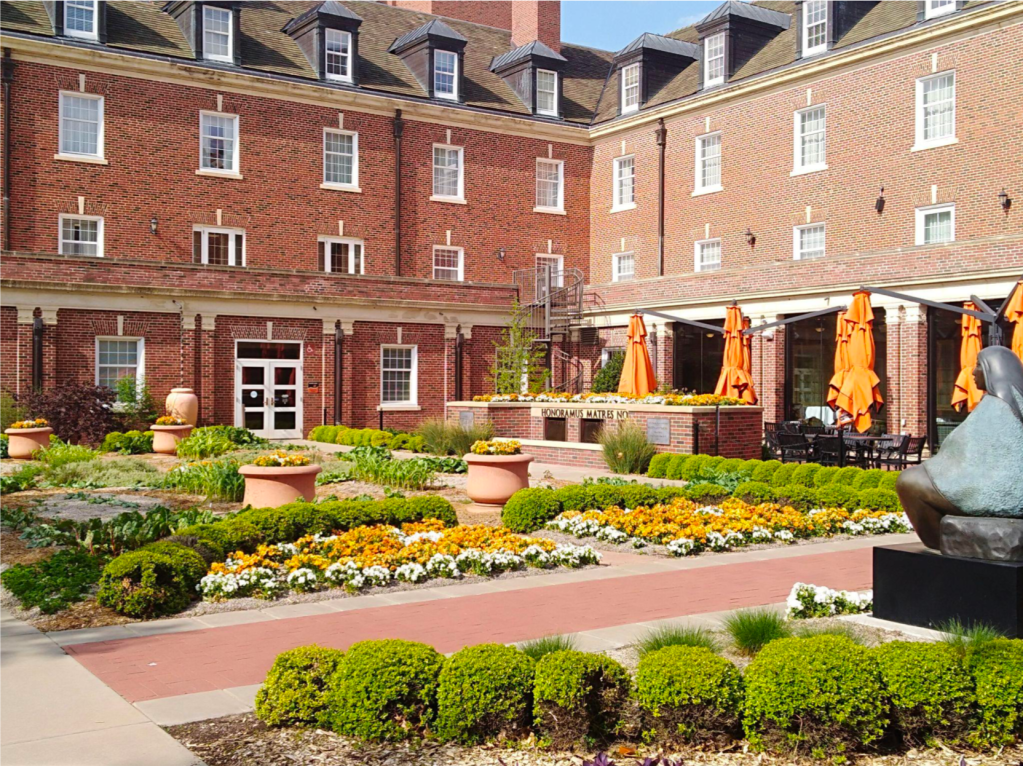
Other than plants, there are other spaces that are kept empty except for grass. These spaces occasionally serve an extra purpose and are used as a place of display, offering a large platform to show art as an example. More permanent artworks of statues and sculptures are dispersed throughout the campus and are often placed with plants together, producing a finer look.
With how much resources are used for improving and maintaining the appearance of the campus, it may bring the question of what this offers other than just looking good. An extensive document titled the Oklahoma State University Campus Landscaping Master Plan, written in 2011 clearly states its purpose:
The Oklahoma State University Campus Landscape Master Plan is intended as a flexible tool that will guide the physical development of the campus, creating a framework for future growth that also preserves the University’s unique heritage and culture.
OSU Facilities Management: Landscaping Services
In this it has succeeded. The described heritage and culture is apparent within the campus environment, the buildings scattered throughout, and the overall image they create. The physical space within helps the college show an identity of its own.
By maintaining a pleasing appearance, a college can help its popularity with a positive image of it. Even further, a college can stick to a theme which can help project ideas associated with it. OSU has accomplished this by using a consistent color theme heavy with Orange. This theme is seen not only in flowers, but also in most of the architecture and is thoroughly ingrained into the design. By having a constant theme and forming a sort of ‘brand,’ which stands for its own ideas and identity. “[Buildings] represent social ideals; they are political statements; they are cultural icons. Architecture is surely our greatest physical symbol of the idea of community” (Goldberger, 2009). The consistency of OSU’s branding in landscaping helps to materialize pride and support for its ideals as an Oklahoma college, while also working as a form of advertising to display a manifestation of their values. People can be swayed to go to a place that they believe they can fit in and and enjoy which is aided by a college’s presentation of itself.
A space creates more psychological effects outside of branding. The appearance of a place can have a significant impact on mood and how you feel. There have been many who have tried to understand what happens to the mind as it is affected by the space a person is in. Paul Goldberger, architect critic and writer of Why Architecture Matters, explains in his book that he believes architecture’s true purpose is as an artform to inspire those that witness it. Seeing architecture as an art helps explain how it is able to bring up emotions within people. You are surrounded by the space you are in and can experience feelings that the creator of that place wanted it to emit.
Even places that are not man made have a direct impact within one’s psyche. The sense of your surroundings can help relieve stress and anxiety especially with exposure to nature and the natural world. These are especially useful in a college situation where students may be away from home and in a place new to them. Although not exactly natural, landscaping still provides a connection with the natural world and brings along some of its benefits with it. Taking care to maintain enjoyable places on campus allows more places where students and staff alike can take time to relax. In doing so, overall productivity can benefit. You don’t even need to actively use such places to gain such advantages. Simply walking past and observing can be enough to help your emotions if you find it to be pleasant.
It isn’t hard to find how the Stillwater campus has affected people. It helps uplift some people and inspires others. Steve Dobbs is of the latter and has played a large role in designing landscaping features, both present and planned, as the OSU Director of Landscaping Services. He has had a career largely intertwined with OSU and “began in 201l,… Transforming the grounds [as] an ongoing process ever since then” (Eubank, 2021). This man is just one of many landscaping staff that shape the campus and affect the lives of those who enjoy what OSU has made.
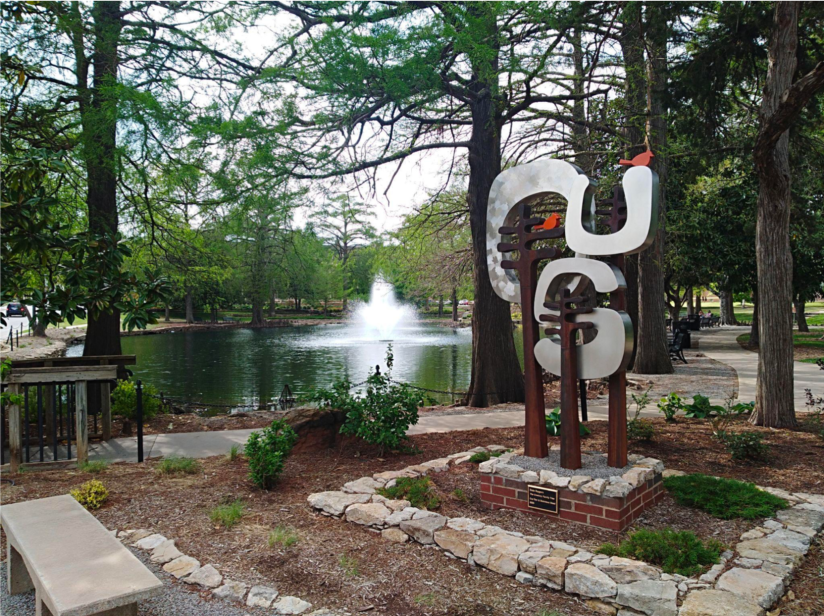
A few pictures of OSU’s Stillwater campus, by the author 
An often busy walkway right next to the Edmon Low Library. 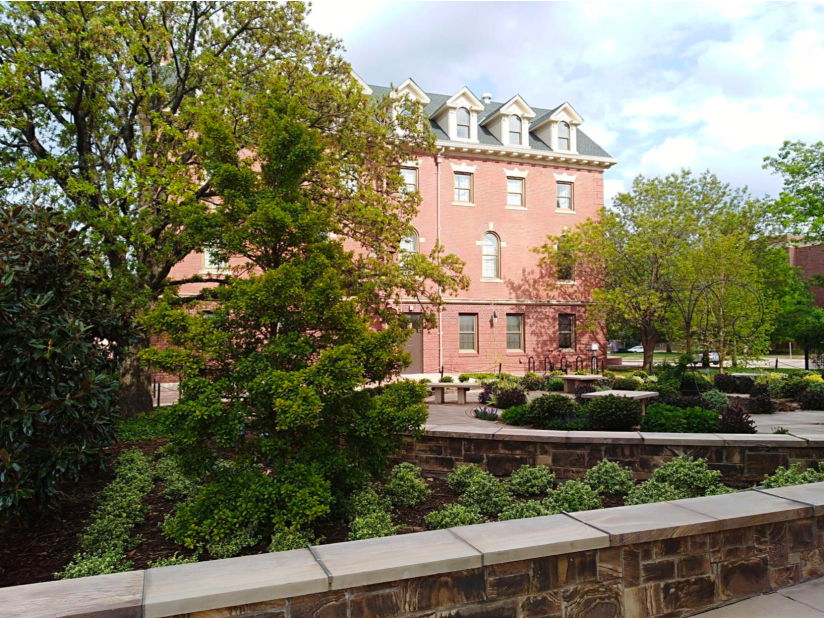
Small garden area next to Morrill Hall. 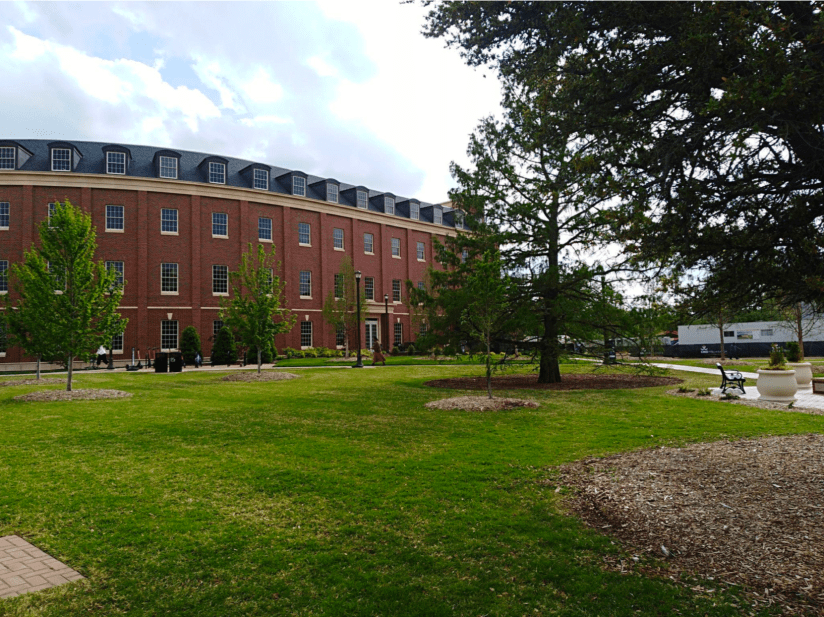
A rear view of the Spears School of Business. 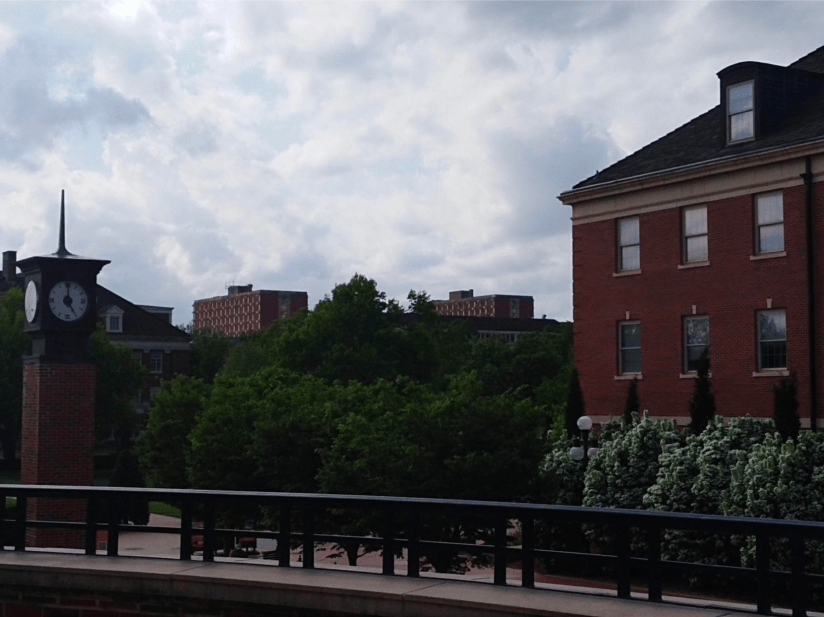
Sight from the second floor of the Student Union. 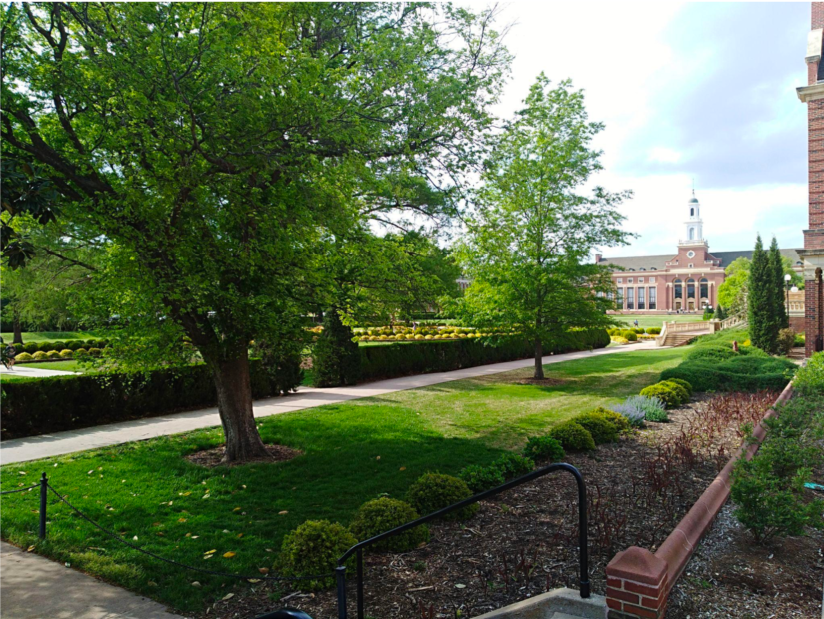
An alternate angle of the Edmon Low Library and Formal Garden. 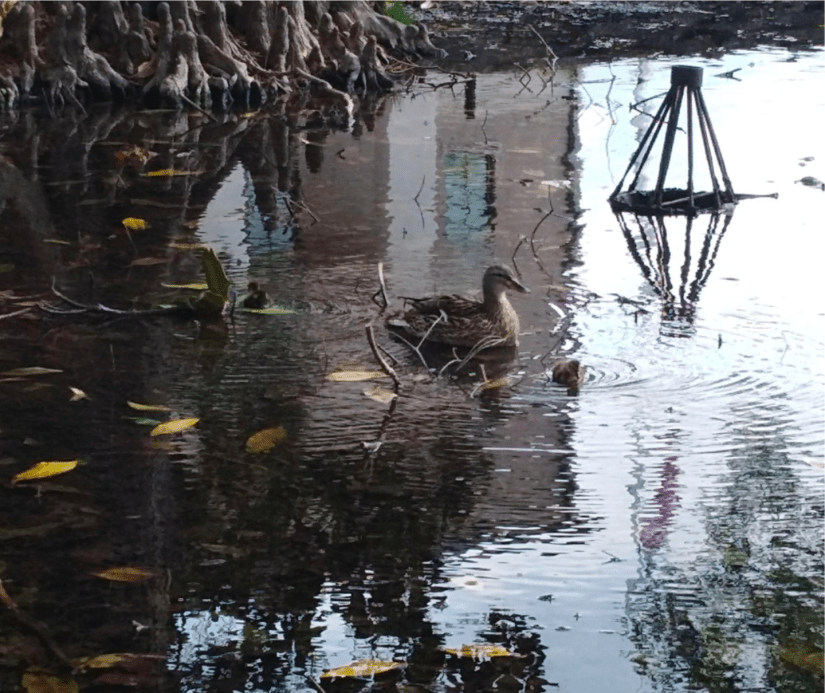
Ducklings with their mother, obscured in the earlier image of Theta Pond.
Works Cited
Balmer, John M.T. “Corporate identity, corporate branding and corporate marketing ‐ Seeing through the fog.” European journal of marketing, Vol. 35, no. 3⁄4, pp. 248-291.
Eubank, Carli. “A Rewarding Return.” Cowboy Journal, 17 Dec 2021.
Goldberger, Paul. Why Architecture Matters. Yale University Press, 2009.
Sternberg, Esther M. Healing Spaces: the Science of Place and Well-being. Harvard University Press, 2009.
OSU Administration and Finance: University Budget, Oklahoma State University, adminfinance.okstate.edu/budget/. Accessed 18 Apr. 2022.
OSU Facilities Management: Landscaping Services, Oklahoma State University, fm.okstate.edu/about-us/landscape/landscape-services.html. Accessed 18 Apr. 2022. Payne, Emma A ; Loi, Natasha M ; Thorsteinsson, Einar B; Capolongo, Stefano ; Stefano
Capolongo. “The Restorative Effect of the Natural Environment on University Students’ Psychological Health.” Journal of environmental and public health, Vol. 2020, 2020, pp. 1-10.
“Public Art on OSU Campus.” OSU Museum of Art, museum.okstate.edu/art/public-art.html. Accessed 18 Apr. 2022.
Roman, Lara A ; Fristensky, Jason P ; Eisenman, Theodore S ; Greenfield, Eric J ; Lundgren, Robert E ; Cerwinka, Chloe E ; Hewitt, David A ; Welsh, Caitlin C. “Growing Canopy on a College Campus: Understanding Urban Forest Change through Archival Records and Aerial Photography.” Environmental Management [New York], Vol. 60, no. 6, 2017, pp. 1042-1061.
Sampath, Sudharsanan. “How Architecture Affects Human Behavior.” Youtube, uploaded by Northern Diaries Originals, 16 May 2020, http://www.youtube.com/watch?v=zSgrVYc6AW0
Smith, Jennifer C. “The South’s Most Beautiful Colleges.” Southern Living, http://www.southernliving.com/culture/school/beautiful-college-campuses#381465. Accessed 18 Apr. 2022.
“The Botanic Garden at OSU is Undergoing Big Changes.” Stillwater Living Magazine, 8 Aug. 2020, stillwaterliving.com/the-botanic-garden-at-osu-is-undergoing-big-changes/. Accessed 18 Apr. 2022.
Wilkerson, April. “Making landscaping greener: Oklahoma City University’s efforts pay off in more ways than one.” The Journal record [Oklahoma City, OK.], 12 Nov. 2009.

 archiveoklahoma.com