researched, scripted, and produced by Sam Leach, Fall 2019
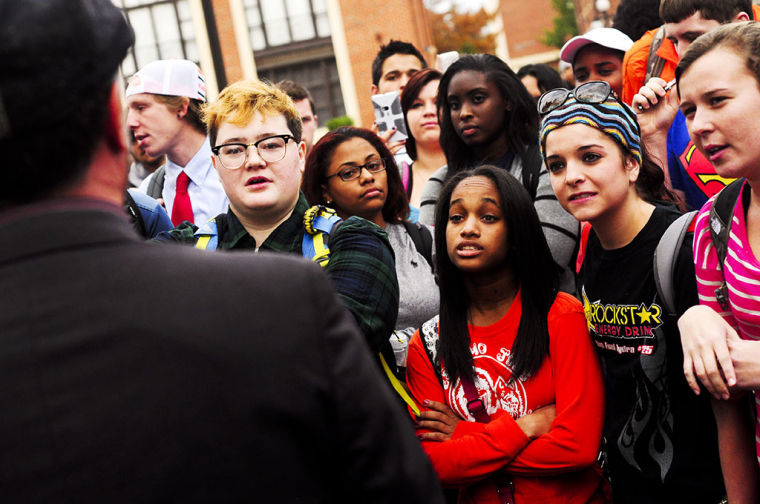
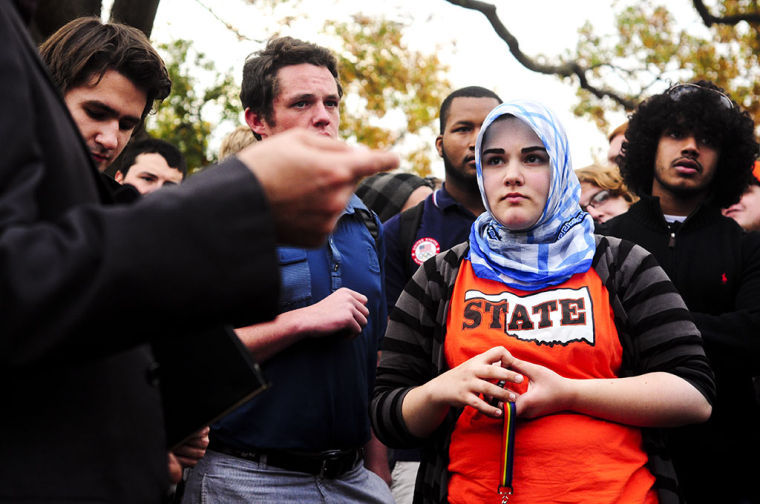
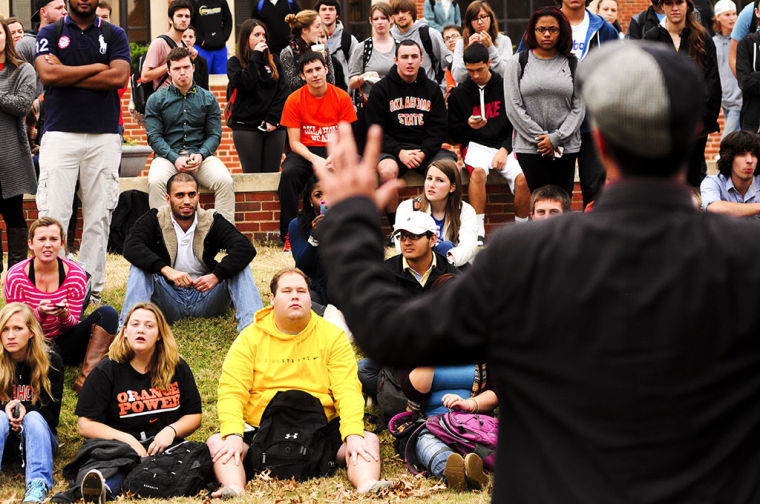
Images adapted from “Preacher Bob Damns College Students” (The O’Colly, Nov. 11, 2013)
Free Speech and the Limits of Religious Tolerance on OSU Campus
From my first day as an OSU student, I saw the exercise of freedom of speech playing out all around me, so I initially began this project wondering about the people next to the library lawn who often hand out little papers or candy to the students passing by on their way to class. I had never experienced something like this before and I began to wonder about the rules that were involved with directly interacting with students. How did they get here? Did they have to get a permit? Have they just slipped through campus security and we’ve all just accepted their presence? These and other questions led me farther down the rabbit hole of wondering about “campus missionaries.’ A few weeks later, I heard about Preacher Bob, a really outspoken guy who comes to campus every year and basically just yelled at the students. I once again started to wonder about the rules with this guy, and asked around. I got basically the same answer from every student I asked: “Yeah we don’t like him, but we can’t really stop him either. He still has freedom of speech rights.” In the case of freedom of expression, both university affiliates, like students, faculty or staff, and members of the general populous still retain their First and Fourteenth Amendment rights on University campuses. Many universities choose to implement varying forms of restrictions on speech for their campuses in order for their school to remain a place where academia and students can flourish without fear of oppression.

“Yeah we don’t like him, but we can’t really stop him either. He still has freedom of speech rights.”
Random OSU student, talking about “Preacher Bob”
Before I get too buried into the depths of everything that I found, I would like to refresh you on some of our country’s amendments, and introduce some vocabulary that is important to this discussion. First, we are reminded of the First and Fourteenth Amendments of the United States Constitution. The First, in summary, prevents the government from making laws that establish a state religion, prevent the freedom of religion, or curtail the freedom of speech, freedom of the press, freedom to peaceably assemble, and the freedom to petition the government.
Congress shall make no law respecting an establishment of religion, or prohibiting the free exercise thereof; or abridging the freedom of speech, or of the press; or the right of the people peaceably to assemble, and to petition the Government for a redress of grievances.
The First Amendment of the US Constitution, 1789.
The part of the Fourteenth Amendment that applies the most to freedom of speech cases is the Equal Protection Clause, which guarantees that all citizens have the right to equal protection by law.
No State shall make or enforce any law which shall abridge the privileges or immunities of citizens of the United States; nor shall any State deprive any person of life, liberty, or property, without due process of law; nor deny to any person within its jurisdiction the equal protection of the laws.
The Equal Protections Clause, Fourteenth Amendment of the US Constitution, 1789.
Now for the wordy jargon, the first idea being “speech codes,” which I first saw mentioned in Micheal Waltman’s paper “The Normalizing of Hate Speech and How Communication Educators Should Respond.” In this essay, Waltman says speech codes are “rules and regulations that punish the use of derogatory names, expression that stigmatizes or victimizes individuals, or singles out a person, group, or class of persons based on race, religion, gender, handicap, ethnicity, national origin, or sexual orientation” (245). Another important term is hate speech, which is defined by Samuel Walker’s book Hate Speech: The History of an American Controversy, where he cites the speech code from the University of Michigan as “any behavior, verbal or physical, that stigmatized or victimizes an individual on the basis of race, ethnicity, religion, sex, sexual orientation, creed, national origin, ancestry, age, marital status, handicap, or Vietnam era veteran status” (127). Learning specifically what these terms were helped to spur me into the beginning of my research.
I started off thinking that I would unearth some crazy secret that the university had buried for years, or that I would find some outdated rules that could put the university in hot water if they were ever taken to court for it. Instead, I was pleasantly surprised to find a set of rules published by OSU called “Student Rights and Responsibilities Governing Student Behavior”. For whatever reason, the speech codes were tucked into the back of this document, behind pages and pages of basically what a student could get in trouble for and what the consequences would be. The section I found focused more on what students could do to utilize their freedom of expression on campus, and what the university set as guidelines for what they are and are not allowed to do. It states:
“The freedom of expression and assembly as guaranteed by the first and fourteenth amendment of the United States Constitution shall be enjoyed by all members of the academic community. Free discussion of subjects of either controversial or noncontroversial nature, even when they are considered to be offensive or in poor taste, shall not be curtailed. Although our Constitution establishes a sweeping commitment to these freedoms, it is well recognized that there is no absolute right to assemble, or to receive or present expression. As described below, permissible limitations include only those based on reasonable time, place or manner requirements and, in extremely rare circumstances, those based on content. The fact that certain content based limitations on expression have been established as legally permissible does not create on obligatory or responsibility to the University or any of its officials or employees to exercise any form of limitation or control of expression. Rather, because of its educational mission, it is the responsibility of the University and its officials to actively encourage free and open inquiry by avoiding and resisting limitations of expression.”
(Current Codes. Oklahoma State University Students Rights and Responsibilities Records.)
The code later defined the kinds of speech that are not protected, being speech or expression that falls in the category of either a clear and present danger, fighting words, and obscenity. To be honest, this came as a bit of a shock to me, since I had expected the OSU speech codes to have more regulation, because I expected the opinion of the University to align more with the words from Campus Hate Speech on Trial, which thought universities should have “…an awareness of the severity and frequency of hate speech incidents and of the special responsibility of a university to foster student growth and well being that (primarily) grounds the view that hate speech should be banned from campuses” (Sheill 17). This is a very reasonable opinion to maintain. So many of the students pursuing higher education are living away from home for the first time, so many schools place a lot of importance on the students’ transition to university life, making the university a ‘safe space’ of sorts.
The ‘special snowflake’ ideal is often dismissed in cases of free speech, because many think that there should not be exceptions to the rules just because people might get “offended.” In The Shadow University, the reader is given the perspective of those on the side arguing for freedom of speech and expression:
The defender of free speech… is forever being told, on American Campuses, that he or she is seeking, specifically to make the campus safe for ‘racism’, ‘sexism’, or ‘homophobia’. That is true if what one means that the defender of free speech seeks to make the campus safe for the expression of all views, and for the clash of visions, ideas, and passions.”
(Kors and Silverglate 100)
To an extent, attorney Lee Rowland agrees. In her TEDx talk called “Free Speech Realities and Myths” she brings up an interesting comparison between the protests of Colin Kaepernick and the Unite the Right rally participants, and the response that President Trump had to both of them “[calling] the marchers at Charlotesville ‘very fine people’, while reserving his ire for black football players who take a knee as ‘sons of bitches’. Your hate speech may not be the government’s idea of hate speech.”. The idea here is that you cannot pick and choose where to give and withhold rights. In a bold comparison, if you let the Nazi protest, then you should also let the NAACP member protest, and in a lot of cases, people hate that. But Universities have taken up the ideas similar to those in The Limits of Religious Tolerance which highlights “If he believes it, then it’s true for him, right?”(Levinovitz 9). Thus, OSU lets all ideas in opinions – within reason – to exist in the school because of rights guaranteed by the Constitution.
Works Cited
Current Codes. Oklahoma State University Students Rights and Responsibilities Records. Oklahoma State University Archives. (link)
Kors, Alan, and Harvey A. Silverglate. The Shadow University: The Betrayal of Liberty on America’s Campuses. The Free Press, 1998.
Levinovitz, Alan Jay. The Limits of Religious Tolerance. The Amherst College Press, 2016.
Rowland, Lee. “Campus Free Speech Realities and Myths.” YouTube, uploaded by TEDxTalks, 13 February, 2018. (link)
Sheill, Timothy C. Campus Hate Speech on Trial. University Press of Kansas, 1998
Student Code of Conduct, Fall 2012. Oklahoma State University Students Rights and Responsibilities Records, . Oklahoma State University Archives. (link)
Walker, Samuel. Hate Speech: The History of an American Controversy. University of Nebraska Press, 1994.
Waltman, Micheal S. “The normalizing of hate speech and how communication educators should respond,” Communication Education, vol. 67, no. 2, 2018, pp. 245-268.
Winrow, Sierra. “Students protest outside Whitehurst Hall after second blackface incident.” O’Colly, 23 Jan. 2017. (link)
 archiveoklahoma.com