
By Amanda Ellis
Spring 2022
It is often said that you never know what someone else might be going through. This common phrase can especially be applied to people that have developed eating disorders. Most people think that an eating disorder is defined by the three most known types: binge-eating disorder (BED), anorexia nervosa (AN) and bulimia nervosa (BN) (Ellis et al.). However, eating disorders are much more than that. An eating disorder (ED) is simply any abnormal or disruptive eating habit. This includes, not just BED, AN, and BN, but also, avoidant-restrictive food intake disorder (ARFID) (Ellis et al.). Because it is not widely understood, it can sometimes be difficult to spot, and therefore, never confronted. Research has shown that eating disorders within college populations are increasing. As an individual navigates their time spent in college, many factors have the potential to cause them to develop an eating disorder. In order to lessen the number of individuals in college with eating disorders, knowledge of the topic at hand, the presence of it here on Oklahoma State University’s campus, and awareness and resources to help must be addressed.
The goal of this essay is to show the presence of eating disorders among college students and how those eating disorders can impact their life. Instead of just taking a look at eating disorder statistics across the United States, this essay is going to reveal statistics of eating disorders at Oklahoma State University as well. That way it will be clear how crucial it is to be active in bringing about change, rather than letting this growing issue feel distant. The reasons why someone might develop an ED will be highlighted. Because it is a pressing issue, action needs to be taken to put a stop to the growth. Progress of change can be made through education of what the issue is and why people develop ED’s, resources made more clearly available, and overall compassion shown to those struggling. The more a topic is understood, the more change can be made. Awareness and education over eating disorders is essential to lessening the rise of ED’s in college students.
As eating disorders are on the rise in college populations, it is important to investigate the causes of this increase. A popular cause of ED’s is a distorted body image because of an increase of pressure to look and act a certain way among the college scene. For example, the unhealthy diet culture and praise received when being underweight can play a part in developing an ED (Farrar). As feelings of stress, fear of the future, and loneliness rise due to the transition into college and lack of parental guidance and structure, some people tend to cope with those emotions through ED’s (Farrar). Also, the stress of academics has been shown to link to many college ED cases (Claydon et al.). When an individual is stressed, it can lead to neglecting their hunger signals which in turn results in malnutrition to the brain. This leads to an unhealthy cycle. When an individual is not gaining the nutrients they need, their brain cannot perform to the best of its ability or gain an appropriate amount of sleep which results in a decrease of GPA and ultimately causes more stress (Claydon et al.). Lastly, distorted views of fitness have also shown why some college students develop ED’s. The fitness world can be a very misinterpreted place for those that have a tendency to struggle with ED’s. While exercise is certainly important for maintaining a healthy lifestyle and preventing diseases, physical fitness can be over-stressed and become unhealthy if the individual is not working out and fueling their body properly (Parreño-Madrigal et al.). All of these reasons are present on campuses across the nation. The transition from home to college definitely can evoke some negative emotions to rise as students are adjusting to life apart from their caregiver(s). Society has a lot to say about the ideal body type of an individual as it can be seen through television, music, social media, and other platforms. With the pressure of cultural “norms,” adjustment to less structure, and high stakes in the academic world, it is understandable why ED’s seem to be on the rise in college students. Taking a closer look at the statistics and personal stories behind college students with ED’s is valuable to uncovering the truth about the alarming rate of increase.
In order to gain a full understanding of this topic, statistics from studies about EDs on college campuses have been collected. One study that was conducted took a survey of 428 college students. The results of that survey showed that every one in four students dealt with EDs in their lifetime (Fullerdm). It also revealed that 50% of the participants knew of someone that struggled with EDs and that the majority of participants could recognize the most common risk factors for developing an ED, such as depression and anxiety (Fullerdm). However, the participants that reported longtime EDs had a harder time correctly identifying risk factors (Fullerdm). Freshman and sophomores also showed to identify risk factors better than juniors and seniors (Fullerdm). Across the board, females displayed a better understanding of symptoms of EDs than males (Fullerdm). Some participants mistakenly claimed EDs to be a vanity issue rather than a serious life threatening behavior that needs to be addressed (Fullerdm). Eating Disorders, according to Hoffman’s research, has the highest death rate than any other mental illness (Fullerdm). Hoffman hoped that through her research, doors to conversations of symptoms and awareness would educate students and prevent the increase of EDs. Another study that was done shows a few interesting trends about EDs. The research revealed that body dissatisfaction was more associated among women than men. Although eating disorders are more commonly thought of as a behavior women tend to struggle with, more men have said to admit to having an ED (Kwan et al.). The study also found that involuntary disengagement coping caused bulimic symptoms in more males than females (Kwan et al.). It proved that EDs are often developed in men and women as an emotional regulation mechanism (Kwan et al.). It is important to keep in mind that this issue is not just a female problem. The increase in males with EDs suggest that maybe men are finally feeling able to admit having an ED, rather than the occurrence that men had never struggled with EDs before now. These observations go to show how obvious the problem of eating disorders has become across the nation, and the importance of knowing what the symptoms and risk factors of developing an ED.
Although learning the statistics of EDs on college campuses is important, it is even more valuable to narrow down the perspective of the study to Oklahoma State University to recognize the relevance of the issue. I sat down with an individual that will remain anonymous to discuss how an eating disorder in the first semester of college affected them. She is a freshman from Edmond, Oklahoma. After graduating from a small private school, she told me how excited she was to attend a large public university. “I looked forward to more opportunities and more types of people. I enjoyed growing up in the small atmosphere that I did, but I knew I was ready for a large school setting” (Anonymous). In high school, she participated in nearly every sport that her school had as well as student council. Busyness was not a foreign concept to her. However, she did begin to explain how everything she was involved in during her first semester started to add up. “Between pomping, classes, making connections and friendships, I barely had any time to myself,” (Anonymous). She was taking 16 hours and constantly had Greek life festivities taking place. In the midst of all of the craziness of first semester here in Stillwater, she explained that there were also components of her home life and family that began to feed her stress. Her dad was having multiple surgeries, and she worried about his recovery. Stress and comparison were two things that prompted her eating disorder.
“Without even realizing it, I started to compare myself, my new friendships, and my popularity to other friends and/or strangers which began to make me insecure and self-conscious.”
Anonymous
In her case, the eating disorder snuck up on her. It was not something that she consciously decided to do to herself. She struggled with comparing herself to her sorority sisters and new friends. “Without even realizing it, I started to compare myself, my new friendships, and my popularity to other friends and/or strangers which began to make me insecure and self-conscious,” (Anonymous). She noted that she developed distorted body image views. On top of comparison, the dynamic of her dad’s health played a role in the development of her eating disorder. He had to undergo multiple surgeries which was hard on her sister and mom, and she found it hard to be away from her family, unable to help during that time. “With everything happening here and also at home, I began to stop eating. I couldn’t eat. Every time I tried, if I tried, it would just make me nauseous,” (Anonymous). She explained that having a highly restrictive diet was how she coped with her stress.
“With everything happening here and also at home, I began to stop eating. I couldn’t eat. Every time I tried, if I tried, it would just make me nauseous.”
Anonymous
A faithful friend and winter break were two of the reasons she began to eat in a healthy manner again. “I had a friend that would always ask what I had eaten that day or to go eat with her,” she said. This friend had taken notice of the restrictive eating habits or the little comments that Anonymous would make. “Even though I had not told her at that point what I was struggling with, it did not have to be said, I knew she knew, and I didn’t feel alone in it,” (Anonymous). Winter break rolled around and that helped her to regain an appetite. “Christmas break was a good reset for me. Things had calmed down at my house, and spending some time focusing on family without the stress of classes and relationships, I finally got to a healthy place where I started to eat again,” (Anonymous). Anonymous stated that because her friend was consistent and direct in making sure she ate, she began to realize that she truly had an ED. She said, “After getting back to Stillwater for the second semester, I confessed my ED to my friend. I told her that the way she checked up on me impacted me greatly,” she stated. Her friend said that she recognized the signs because she had struggled with body image issues in high school, and she knew how isolating the struggle can be. Anonymous relayed to her friend and to me that she was so grateful for a friend that checked up on her and helped her during her time of need, even though she had not realized she needed the help at first.
Because it is a prevalent issue, awareness of the topic is vital to bringing about change. It is important to know the symptoms of ED’s in order to be able to spot them. Some signs that someone could be struggling with an ED are depression, suicidal ideation, anxiety, a dramatic decrease in weight, and sleep problems (Meyer et al.). Students with ED’s have a higher suicide risk (Lipson et al.). It has been discovered that suicide is the second leading cause of death across the nation for college populations (Lipson et al.). Studies have shown that college students with ED’s have a decrease in their GPA (Claydon et al.). This is because the brain is not receiving the proper nutrients it needs to function, and thus, performance in classes is less than satisfactory (Claydon et al.). In the event that an individual does have an ED, it is important to encourage mindfulness and self-compassion (Meyer et al.). Mindfulness is also a crucial practice as it confronts societal ideals with the challenge of being present with one’s current state, and preventing the striving for an unrealistic goal (Meyer et al.). Self-compassion is “the demonstration of kindness to oneself, the observation of one’s own imperfection as an inevitable aspect of the human condition, and a mindful awareness of one’s distressing thoughts and emotions,” (Meyer et al.). A study has shown that individuals with more self-compassion have overall better mental health, satisfaction with their life, and a greater appreciation of their bodies (Meyer et al.). All colleges are equipped with ways to help those struggling with ED’s. There are counseling centers at every university, but if that is not enough, there are always local counseling centers around the campus that could be beneficial (“Affordable Colleges”). At Oklahoma State University, there are resources that are available to students struggling with mental health, such as ED’s. The Department of Wellness has a website that provides links and numbers to people that can help in the event of a crisis (“Student Mental Health Resources”). There is also contact information of counseling services provided by OSU. Along with the resources of help, there is a schedule of events that promote and encourage mental health (“Student Mental Health Resources”). The seriousness of ED’s on college campuses is very prevalent. It is crucial to be mindful of the common symptoms and signs that someone could be struggling because it only takes one person to make a change in an individual’s life and wellbeing.
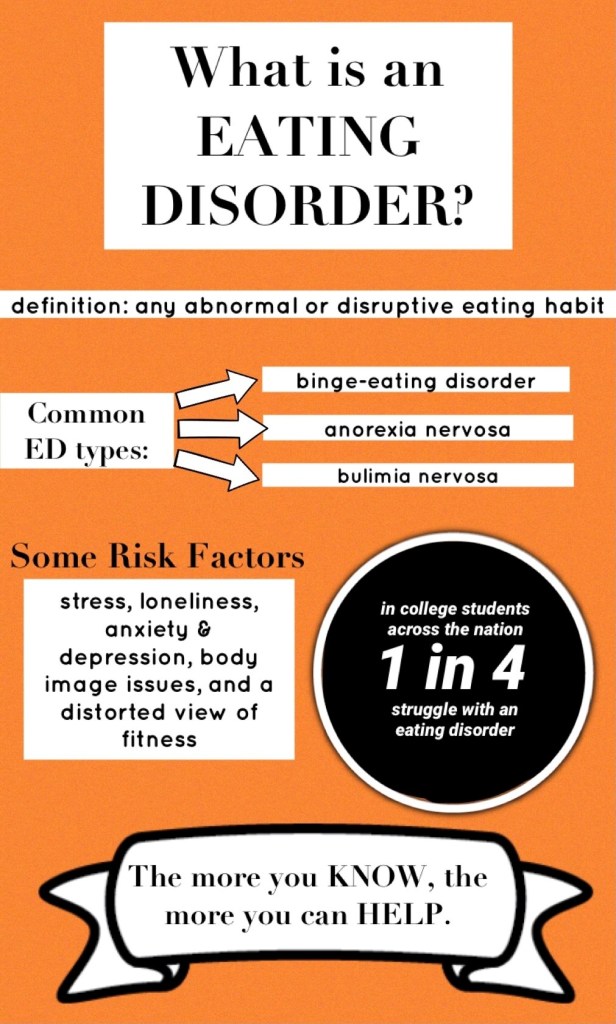
Eating Disorders are clearly on the rise, not just nationally, but also at Oklahoma State University. In order to bring about change, it is valuable to know the symptoms, and risk factors of EDs. Equally important to being educated on the topic is awareness of individuals that might show signs of those things in your own life and encouragement of asking for help. The act of reaching out to someone and/or showing compassion even when an ED is not verbally addressed is incredibly impactful. There seems to be a shamefulness in dealing with an eating disorder because individuals have a hard time recognizing it for what it is and confessing it to someone else. Shame and guilt that are felt with eating disorders have to go. It is important to emphasize the strength in someone dealing with an ED when they are vulnerable enough to talk about it and ask for help. Encouraging someone with an ED to ask for help is one of the only ways that the increase will stop. Anonymous agreed to this interview because she wanted to urge people to know the signs and check up on people that might show symptoms because it could help the person break the cycle. Take this story and research presented as a call to action to aid in the fight against eating disorders.
Works Cited
Claydon, & Zullig, K. J. “Eating disorders and academic performance among college students.” Journal of American College Health, vol. 68, no. 3, 2020, pp. 320–325, https://doi.org/10.1080/07448481.2018.1549556. Accessed 3 March 2022.
“Eating Disorders In College Students.” Affordable Colleges, 23 July 2021, https://www.affordablecollegesonline.org/college-resource-center/eating-disorders/#:~:text=Eating%20Disorder%20%26%20College%20Students%3A%20The%20Numbers%20,athletes%20exhibit%20…%20%201%20more%20rows%20. Accessed 3 March 2021.
Ellis, Essayli, J. H., Zickgraf, H. F., Rossi, J., Hlavka, R., Carels, R. A., & Whited, M. C. “Comparing stigmatizing attitudes toward anorexia nervosa, binge-eating disorder, avoidant-restrictive food intake disorder, and subthreshold eating behaviors in college students.” Eating Behaviors : an International Journal, vol. 39, pp. 101443–101443. 14 October 2020. ScienceDirect, https://doi.org/10.1016/j.eatbeh.2020.101443. Accessed 1 March 2022.
Farrar, Tabitha. “Eating Disorders in College – Mirror.” Mirror, 11 June 2020, mirror-mirror.org/eating-disorders-2-2/college-and-eating-disorders. Accessed 3 March 2022.
Fullerdm. “UC Research Examines College Students’ Knowledge About Eating Disorders.” UC News, UC Cincinnati, https://global-factiva com.argo.library.okstate.edu/redir/default.aspx?P=sa&an=TARGNS0020111101e7av0056t&cat=a&ep=ASE. Accessed 3 March 2022.
Grammer, A. C., Fitzsimmons-Craft, E. E., Laing, O., Pietro, B., & Wilfley, D. E. “Eating Disorders on College Campuses in the United States: Current Insight on Screening, Prevention, and Treatment.” Current psychopharmacology, vol. 9, no. 2, 2020, pp. 91–102, https://doi.org/10.2174/2211556009999200416153022. Accessed 1 March 2022.
Kwan, M. Y., Gordon, K. H., Minnich, A. M., Carter, D. L., & Troop-Gordon, W. “Peer victimization and eating disorder symptoms in college students.” Journal of Social and Clinical Psychology, vol. 36, no. 5, 2017, pp. 419-436. doi:http://dx.doi.org/101521jscp2017365419. Accessed 3 March 2022.
Lipson, & Sonneville, K. R. “Understanding suicide risk and eating disorders in college student populations: Results from a National Study.” The International Journal of Eating Disorders, vol. 53, no. 2, 1 February 2020, pp. 229-238. Wiley Online Library, https://doi.org/10.1002/eat.23188. Accessed 3 March 2022.
Meyer, & Leppma, M. “The Role of Mindfulness, Self‐Compassion, and Emotion Regulation in Eating Disorder Symptoms Among College Students.” Journal of College Counseling, vol. 22, no. 3, 1 October 2019, pp. 211–224. EBSCOhost, https://doi.org/10.1002/jocc.12138. Accessed 3 March 2022.
Parreño-Madrigal, Díez-Fernández, A., Martínez-Vizcaíno, V., Visier-Alfonso, M. E., Garrido-Miguel, M., & Sánchez-López, M. “Prevalence of Risk of Eating Disorders and its Association with Obesity and Fitness.” International Journal of Sports Medicine, vol. 41, no. 10, 2 June 2020, pp. 669–676. Thieme Connect, https://doi.org/10.1055/a-1152-5064. Accessed 1 March 2022.
Student Mental Health Resources – Oklahoma State University. Student Mental Health Resources | Oklahoma State University, 12 Aug. 2020, wellness.okstate.edu/student-wellness/resources.html. Accessed 3 March 2022.

 archiveoklahoma.com