
By Christopher Raun
The first picture, of hundreds I would go on to view, from the archive of soil conservation in the southern plains was a black and white glass lantern slide of two men standing idly beside two yoked cattle and two yoked horses preparing to till a field for planting. To my eyes, this image contained little to nothing relevant to the process of soil conservation and considering the tilling method, would be more at home in a soil destruction archive. Soil, contrary to much popular belief, is far from strictly abiotic. While soil may seem as lifeless as the ground we walk on, which unfortunately includes the soil itself, it is living, loamy, full of microorganisms, nutrient-rich, animated (though we can’t often see it move), and most importantly, the soil is a living barrack that serves as a home for the plants and animals that grow within its expanse.
Unfortunately, in the case of the soil conservation archive, the life and vivacity of soil that I know to exist, is given little thought or representation in the still, faded images of farmers and animals standing on empty pieces of land. The immense difficulty in attempting to conserve a resource as complex, vastly abundant, and fragile as the soil itself would have seemed an unattainable goal. Soil conservation is a relative subject. The natural world is vastly more complicated than any human invention we have yet created. Our ability to fully understand our interactions with the land and foresee all of their possible consequences is more than just limited. It is nothing short of rudimentary compared to the eons-old system developed by evolution by natural selection. Soil conservation, then, is a set of practices thought by humans to halt, mitigate, or reverse the damage we have inflicted on the soil. Soil conservation is a strong effort to cut our losses in terms of soil life expectancy.
Concerning the photographers of the glass lantern slides in this archive, their focus was symptomatic, but only due to the vast nature of the problem they were attempting to document. A photograph of an eroded river bed may display some effects of soil erosion but does little in the way of explaining the complex process which led to the symptom. In the lack of understanding regarding soil erosion, these photographers took a quantitative approach. If nobody knows exactly what is happening to the soil, it’s best to document everything. Even if certain photographs contain little to no relevant information about soil conservation, the possibility that these pictures contain unforeseen evidence on the subject warrants their documentation.
In this photograph, it is clear that the root system on the right permeates deeper into the soil than the roots on the left.
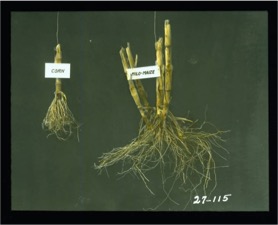
This shows some level of figurative and literal depth in the documentation of the subject. The photographers left a significant amount to be desired with some of their work, but in this case, a deeper understanding of the problem comes to life. By documenting as much as possible in the face of overwhelming obstacles, these photographers stumbled upon a single idea that encapsulates more about soil erosion than twenty pictures of donkeys and farmers.The best piece of evidence to display human ingenuity in the absence of technology is this photograph of corn root systems
Throughout my research, the strange parallel between the soil in this archive and the fundamental nature of our memories continually jumped out at me. Our minds exist on a single axis of time and as we move along this axis we gather information from our surroundings to store in our memories. More often than not, these experiences aren’t individually influential or profound, but in the constant nature of our existence, we occasionally stumble upon experiences that exceptionally influence our lives. The archive, in a sense, becomes an overwhelmingly natural representation of documentation itself. Most of the evidence in the archive is not particularly helpful to understanding soil conservation; However, the few pieces that do manage to capture some of the depth of the issue are further emphasized because of this.
At this point, I had to step back and ask myself, Am I just formulating this connection so that I have something to write about, or did the archivists intend for the archive to be perceived this way? Unfortunately, I can’t believe that the archivists intentionally constructed a lacking archive in order to explore some wider message on the nature of the archive itself. The fact that they did, even if by accident, supports my ideas on the nature of memory more than if this archive was an intentionally artistic exploration.
Many pictures in the archive refer to explicit symptoms of soil erosion like eroded stream beds and vast ditches where fallen soil has blown away to reveal small dirty canyons and improperly cultivated fields. The purpose of this archive is presented as
“A pictorial collection from glass lantern slides documenting the devastation caused by soil erosion and the innovative techniques utilized to successfully conserve soil and water resources on the southern plain” (Soil Erosion and Conservation on the Southern Plains).
An archivist with this goal in mind can begin to understand the surprisingly nuanced nature of the word “devastation.” The slides titled “Cattle on Pasture” begin to make less sense in the context of an archive about devastation, but the wider scope of the archive comes into view. The archivist, or team of archivists who compiled these slides had to showcase all the various forms of devastation on the southern plains environment, only using pictures, with only primitive knowledge in the field of soil science compared to what we have access to today. Some of these slides don’t make sense in the archive, they don’t add any understanding to the subject of soil erosion or environmental damage at all. Some of these slides are just mediocre pictures of trees. If all the labels of pictures and title of the archive were removed the archive could be viewed as an old-timey nature slideshow, but the labels are there and the title and mission of the archive are clearly expressed.
The pictures explicitly depicting practices of tillage farming were particularly interesting to me. One of the prime tenants of modern soil conservation is that almost all forms of tillage are harmful to the soil, yet the practice of tillage has been key to crop cultivation methods for centuries. To ask farmers to cease tilling their land would be similar to asking a skyscraper contractor to continue construction on his building without the use of a crane.
Tillage is simply the breaking up of hardened topsoil in an effort to allow seeds to germinate more easily spreading their roots through the softer earth and yielding more biomass at the end of the growing season. This logic seems to follow until you ponder the complex methods plants have been using to grow and survive for millions of years before humans ever came into existence. The focus of soil conservation is now to return to a more “natural” method of crop cultivation.
This feels like an unsatisfying conclusion to reach. As humans, we should be pushing the barriers of our knowledge and understanding, constantly striving to adapt and create new methods to complete our never-ending lists of tasks. In this light, the focus of soil conservation should be to create new methods and avenues with which we can continue to apply our knowledge of engineering and cultivation while maintaining healthy soil. We need to invent something new to keep our crop yields high and soil healthy.
Arriving at this answer leaves a rather dark but likely turn of events to unfold. If soil conservationists place innovation as their key concern they will begin by looking at present technology utilized by farmers and attempting to improve upon this technology. Crop yields rise using technologically advanced agricultural methods and during this time, more soil is leached of nutrients and organic carbon. People still need to be fed during this period of farming innovation and to achieve the yields made standard by modern farming practices, the soil will inevitably take the brunt of the blow.
Now arriving at this conclusion, I can only see one true answer to the question of soil conservation, and why it’s archive seems so ambiguous. Humanity is a highly evolved parasite that slowly (or not so slowly) leeches resources from the earth and leaves it worse off for our presence.
Before proceeding, two facts must be established. Humans are animals, meaning we exist as bipedal sacks of meat born from an immensely massive phylogenetic tree that began long before we existed as a species, and will likely continue long after the last human has died. The second is that, given our eight-pound brain, the full function of which remains a mystery, we inevitably and consistently forget. Humans are animals trapped by gravity on a big water-soaked rock, and as soon as we figure out how one aspect of our reality functions, we forget another. The importance of this archive lies in its creators: humans who are really trying. We are trying to undo some of the damage we unknowingly wrecked on an environment that we couldn’t have reasoned to be so fragile, and at the same time, we are trying to remember the effort we’ve made. This archive left a lot to be desired upon my first inspection, but it slowly became clear that this archive acts as a testament to our effort. Just as conservationists tried, and continue to try, to fix issues revolving around soil erosion, photographers tried to remember that futile process as best they could through the archive. If it seemed daunting to discover that years of poor farming practice led to a catastrophe, the responsibility for which rested in human hands. It seems courageous, then, to turn back and decide that it was a mistake was worth remembering.
Humanity may very well be classified as a parasite through a certain lens, but unlike any other parasite known to us, humans have the capacity for compassion. Humans recognize their failures as they continue to fail, and history shows that this might be the best we can do. No other animals have the same ability to combat their basic instincts of hunger and survival, and because of this fact, it can become all too easy to separate ourselves from the rest of the natural world. Fortunately for us, the same minds that justify our separation from the world also give us the intellect to re-contextualize ourselves within the world in whatever manner we choose. Some would place humans at the ceiling of the animal kingdom as apex predators of the highest degree. Others in a humbler mindset, akin to that of the soil conservationists, place humanity in a custodial role, as protectors and guardians of the beauty of the natural world. The human mind can separate itself from time and space through the power of abstract thought and thus, insert itself back into the natural equation in whatever fashion it desires.
Many pictures in this collection don’t offer much in the way of understanding the subject and motive of the archive, but the hidden story of the archivists who cataloged all of these photos offers a rich and vivid grasp of what it means to be a human living on this constantly eroding planet.
The soil around us is breaking while we, as humans, are constantly aging, learning, and forgetting. There is an undeniable fast track towards total chaos that we can see through only a slightly zoomed out frame of our own lives. The soil conservationists in these photos and the archivists who recorded them had the same end goal, to slow down the unending race towards the destruction of the very ground we stand on and the memories we have of it. Soil erodes in the same way our minds do. As a mind can become overworked and prone to thoughts and memories slipping through the cracks, soil can be overused and spoiled, allowing nutrients and plants to wither away. The parallel between fighting to save the soil and the fight to remember our battle began to feel like the same thing. The act of remembering our own lives and the lives of our ancestors takes place entirely within the frame and in the exact instant of the moment. Time washes over us and erodes the fabric of our existence as we make our way through life, but the human mind fights back with the power of memory.
Archive
“Soil Erosion and Conservation on the Southern Plains” Digital Collections @ OKSTATE.
dc.library.okstate.edu/digital/collection/soil/search
Fall 2017
Christopher Raun is currently a sophomore at Oklahoma State University. He hopes to pursue a career in english education and continually cultivate his mind for the rest of his lonesome years.
 archiveoklahoma.com