
By Sarah Guernsey
People have always told me that history repeats itself, so walking into the first day of my Critical Analysis and Writing II class I expected nothing more than the same meaningless, boring, and time consuming assignments that students are plagued with, year after year. The papers with topics that you pretend to be passionate about in order to get a good grade, or you write about something because it will be easy and you know your teacher will agree with your idea. After the first class it seemed that my low expectations had been met and I would spend my semester reading about things that didn’t interest me or just doing the paper to get it done, rather than really diving into a topic that I care about. I figured this semester would be just like any other, but when my professor handed us this Archive Story and explained what it was and how we could spin it to make it about something meaningful to us I got excited. I began to think of ways I could turn an archive about Oklahoma, possibly the most boring state in the United States of America, into something that I had a passion for and would enjoy learning and writing about. I was sitting in my dorm with my roommate one evening trying to find an archive that I could potentially spend four months looking at. Her incessant whistling made it hard to focus and I was starting to get frustrated and discouraged. Clicking through what felt like an endless list of archives, looking through the contents, and feeling little to no connection with any of them, it seemed hopeless that I would find something that genuinely interested me. Sitting in my bed, I decided that I was just going to put my laptop away and go to sleep, my bed was feeling incredibly comfortable, so that seemed like the best idea for a tired and frustrated college student. Just as I was about to click out of the list, I stumbled upon a digital archive about soil erosion and conservation. Near the bottom of the list of approved archives was an archive that I thought I could relate to and I would actually enjoy reading, learning, and writing about.
I developed a passion for conservation my junior year of high school through a project that would bring sustainable food to a developing area in Africa. This project would test different mixes of ingredients for fish food and it would also involve a group of students going to Africa to build a fish habitat and help them learn about sustaining their fish population so that they don’t overfish that area. While I did not attend the trip to Africa, I helped design tools to help the locals catch algae in their rivers and grow and harvest banana leaves as ingredients to put in the fish food. While creating this fish food, we took into account ingredients that were native to the area, so that they could always replenish the food on their own. We also gave them the tools to grow the ingredients and the recipe and make the fish food, because we wanted them to learn to become dependent on themselves rather than having to depend on others to bring them food. My teacher had a saying that read, “If you give a man a fish, you feed him for a day, but if you teach a man to feed a fish, you feed him for a lifetime.” While the group of students were there, they made sure to teach the people there that they needed to sustain and replenish their resources, or they will die and no longer be available to them. This is something that should be emphasized in regards to our Earth and its resources today, if we continue to overuse resources and not allow them to replenish they will no longer be available to us. Being part of this project helped me develop a true passion for conservation and sustainability, so seeing an archive with a focus on environmental conservation got me more excited about composing this project and furthering my knowledge about the topic. One example of what could potentially happen to our Earth as a result of overusing soil and water resources is found in the slide “Barren Rock and Soil” from the soil erosion archive, which shows the true devastation caused by this misuse of resources. When people actually see the destroyed land rather than just hearing about it, it makes the problems more real to them and they are more inclined to make a conscious effort to make a change, which is something that the Soil Erosion and Conservation in the Southern Plains archive achieves through the use of visual aids.
Once I started exploring the Soil Erosion and Conservation in the Southern Plains archive from the Oklahoma State University Library, I found that it was simply a collection of pictures of the land in the Southern Plains. Some pictures such as “Significant Soil Erosion Caused by Water” showed devastated and infertile land, while others like “Green Belt Between Road and Field” showed more fruitful land, and still others including “Man with Tractor Working Contour Terraces” depicted famers using different farming techniques. It took even more digging to find out what time period these photographs were from because you needed to click on every individual picture to see that all of them were “circa 1930”. It was interesting to see how this archive was set up in terms of how hard it sometimes was to find the simple information, such as dates and origins of the materials. A researcher would have to do quite of bit of searching to find the information needed to know what the pictures in the archive were actually presenting. One way to get around this difficulty was to use the search bar at the top right corner of the archive itself, which would allow someone to type a word like “contour”, and it would then pull up every picture with the word in its title. This made it so much easier to find the pictures that directly related to the idea of soil erosion and conservation. Of course by this time I had discovered that this archive was a collection of pictures from the Dust Bowl era that swept across the Southern Plains and devastated the inhabitants of the land. The archive itself did not present much information on the Dust Bowl, so I had to use outside sources and my prior knowledge of the events to come to the conclusion that this archive was a collection from the Dust Bowl. The Dust Bowl was a period of time in the 1930s when, due to overuse of land and poor farming techniques, the land was ripped of all its resources, causing the soil to be infertile. In addition to the unusable land, there was a drought at the time and high wind storms that picked up the dry, loose dust and blew it around, making them full blown dust storms. With this knowledge of the Dust Bowl, and knowing what kind of things may have caused it, I started to question what could have ended devastation like this. What might have caused the dust storms to stop and what did the people change about their lifestyle that might have lessened the storms? That’s when I truly understood the purpose of the archive itself and found that the archive actually had a focus on the innovative techniques that farmers used to help restore the land to a farmable state and, quite literally, pull themselves out of the Dust Bowl. This sparked a particular interest for me to think about the world today and the environmental devastation we face; the trash filled oceans, the depletion of the ozone layer, and even the landfills where garbage continues to rot. From this point, I started to form the idea that it could be argued that it’s important to look to the triumphs of the Dust Bowl to see that there’s hope for our dying planet today.
The environmental science class that I took in high school really sparked an interest in environmental conservation and showed me the real problems faced by environmental researchers today. It would be easy for them to say that the planet is already too far gone and that it would be pointless to even try to restore it, but I imagine that’s also how the farmers during the Dust Bowl felt when they looked at the destroyed land they live on. Imagine if they never tried to change their farming techniques, maybe another dust bowl would have happened or even something much worse, but they did change their ways and the land of the Southern Plains are fruitful once again. My point is that we can’t give up on restoring Earth, instead, we should look to times like the Dust Bowl to see their successes and try to implement some of the same ways of thinking into today’s problems. One of the ways that Oklahoma has taken action to educate people about conservation was establishing the Department of Environmental Quality in 1993, the same year that this archive was collected and compiled. It could be that the archive was created in conjunction with this department in order to help educate students across Oklahoma about the Dust Bowl and the new techniques, such as terracing and rotating crops. This archive is presented in a way that shows these innovative techniques and new ways of thinking, which has the potential to inspire students and future researchers not to give up on the planet, but to find new ways to protect and conserve the resources of Earth. Seeing first hand accounts of farmers taking charge and making changes in their lifestyle,
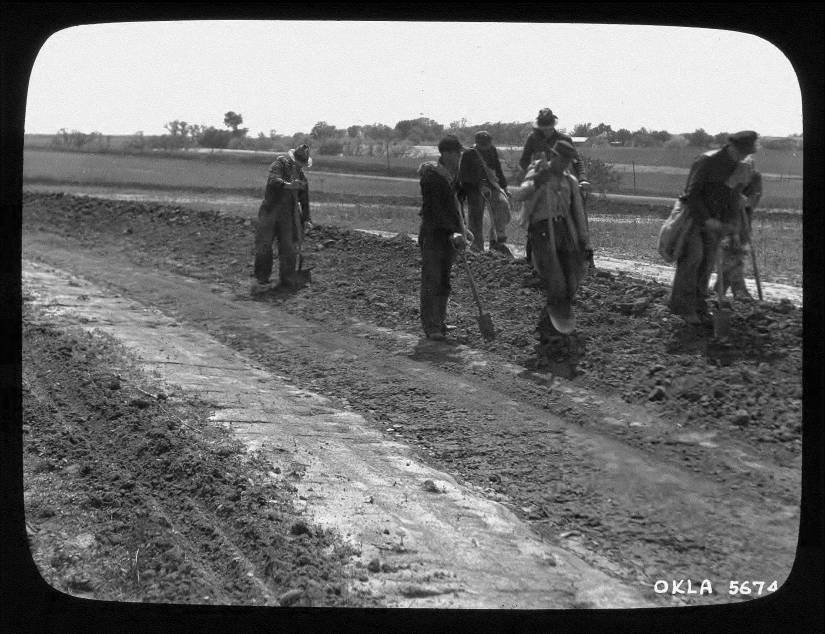
like in the picture “Group of Men with Shovels Working on Terrace,” has the potential to inspire people in today’s society to make changes in their own lives in order to prevent something like the Dust Bowl from happening again. The men in this picture don’t look like the typical, downtrodden victims that come to mind when thinking about the Dust Bowl era, rather their posture shows a more confident and resilient group of men working to correct the farming mistakes, which is something that motivates more people to make a positive change. After discovering some of the reasons behind creating the archive I was able to dig deeper into the pictures of the devastation and the techniques used to recover from the Dust Bowl to further the idea that, because history repeats itself, it is important to look back on events like the Dust Bowl and learn from their mistakes, as well as their victories.
Through the soil and erosion archive I was shown pictures of techniques such as terracing crops and crop rotation. These new techniques were implemented in order to protect and conserve the natural resources of the land in the Southern Plains. Again, the archive only contained pictures of these techniques, and I had to look to outside sources to find out how these techniques really worked. Crop terracing is described as a method of farming that reduces water loss and soil erosion by planting crops in a hillside, much like a staircase. This technique can be seen in the archive as a picture titled “Aerial Image of Terraced Crop Land,”

circa 1930s. Oklahoma State University Library Archives, Soil Erosion and Conservation on the Southern Plains.
which I happened upon when searching for ways that farmers combatted the Dust Bowl. Prior to the Dust Bowl, farmers would clear a section of land and begin to plant their crops in straight lines across the whole section. This allowed land to be eroded away by wind and water because there were no trees with roots to hold the soil in place after the crops were harvested. This image of the terraced crop land shows how big of an impact this change had on the area. By showing a different perspective of the land, people can really see the big change made by many farmers making an effort. This can motivate people in today’s society to make small, effective changes to their everyday lives because they can see a more positive outlook on the impact that their changes can make. Another system of farming used to reduce infertile land was crop rotation, which was a simple procedure that involves rotating a certain crop to a different area to be grown in order to let the land revive itself and replenish the natural resources. By farming one area for a few years and then giving the land time to restore its nutrients, the farmers were able to better sustain their fruitful land and ensure that the land would be farmable for many years to come. By looking back at the pictures of the techniques displayed in the archive that were used by farmers during the Dust Bowl era, communities are able to see their success and may learn to implement similar methods to help sustain, conserve, and restore Earth to a healthier state. This archive not only shows the successes of the farmers, but shows the devastation caused by the Dust Bowl, which allowed me to explore the idea that people of today need to ponder the impact that the state of the world has on them, such as how the same air pollution, water crisis, and soil degradation that was experienced in the Dust Bowl can affect them today. During the Dust Bowl, many people died due to the inhalation of dust filled air and the lack of available food due to the drought, and in today’s society people are threatened with death or disease caused by polluted air and unsafe living environments. Many people ignore the threats of disease and death because they are not directly seeing the impacts around them. Scientific research has proven that it can take months or even years to see the symptoms of a chronic disease developing, so someone may not even know that they have been impacted by polluted air until it’s too late to find a cure. Diseases such as lung disease, leukemia, heart disease, and birth defects can all be caused by inhaling polluted air. This pollution and overuse of resources has consequences not only for the people directly involved, but for everyone who relies on Earth to provide what they need to survive. Problems like this must be remedied in order to keep people safe, which is why I appreciate the Soil Erosion and Conservation on the Southern Plains archive. Even though it seems to be just a collection of pictures, it expresses an incredible message to citizens who may have given up on saving the Earth by showing a picturesque story of perseverance through the Dust Bowl’s destruction. This is an idea that needs to be spread to more populations, and I think this archive is a step in the right direction.
Looking through this archive, forced me to think about the environment I live in and how my surroundings could impact my health. Exploring the pictures on display of the devastation caused by the Dust Bowl helped me further the idea that looking to the past can help ensure that we don’t repeat the mistakes made by the people before us. I know that everyone says history repeats, but taking a deeper look into the Soil Erosion and Conservation of the Southern Plains archive made that idea feel more real to me. I have grown up in Oklahoma, so I have had to learn about the Dust Bowl in the same way almost every year in school, but being able to look at a different aspect of it made learning about it more interesting. The idea of environmental conservation that the archive focuses on gives people a more positive outlook on the time period and gives them a real example of coming back from destruction and devastation. This is perhaps the most important thing to take away from this archive in order to make a real change in our world today. If the farmers of the Dust Bowl can change their habitual farming methods, the people of today can put in the effort to make small, effective changes to their everyday life so that we can conserve, protect, sustain, and restore Earth. It is said that Earth doesn’t need humans, humans need Earth, which shows how important it is to protect Earth and all of it’s resources, so as to protect the human race for generations to come. The Soil Erosion and Conservation of the Southern Plains archive seems to be taking a huge leap in spreading awareness to Oklahoma students and residents by showing real accounts of a society pulling themselves from devastation and restoring an area, much like what should be done to restore Earth today.
Fall 2017
Sarah is a current freshman at Oklahoma State University. She is in pursuit of a Bachelor of Science in Elementary Education and plans to teach in Oklahoma schools after graduation in May of 2021.
 archiveoklahoma.com