
By Anna Rechtin
Spring 2022
The foster care system is something that is bound to have faults. The foster care system can be a temporary home, a parental reform organization, or an orphanage. When it is a temporary home, the system is supposed to take children temporarily from inadequate parents. In contrast, the parents learn to care for children, become financially stable, or become responsible enough to care for their child again. But many parents cannot understand how to care for a child properly, so children have become stuck in the foster care system. Although the foster care system is adequate today, there are still improvements needed so that children can get the care they need and deserve, which community organizations try to improve upon. Gaps in the system are made easily due to negligence, and more significant areas need help first. But these gaps can change the life of a foster kid for better or for worse, and that is what an involved community helps with, like in Stillwater, Oklahoma.
The foster care system is a broken system with so many things to improve on. When it gets down to the basics to see what can improve the system is money and more volunteers. The people who feel the full effect are those who work directly with the system, like caseworkers. The turnover rate of the caseworkers is around 33% in Oklahoma, according to the Schusterman Family Foundation’s Priorities for Change 2011. (Oklahoma Foster Care System Improvement Task Force 6) The high turnover rate makes it so caseworkers are often understaffed and outworked. Even though the average salary of caseworkers in Oklahoma is $53,077, many caseworkers still quit their jobs. (“Home.” 1) Caseworkers leave their jobs because of the emotional toll of working in the foster care system. An Illinois caseworker said,
“It’s a very heavy field, most people don’t deal, every day, with children who have experienced sexual and physical abuse.”
(Children’s rights 1)
People who become caseworkers don’t typically work for the money but instead for the children.
Another problem that arises with the lack of caseworkers after hiring new ones is the amount of time for training. Anytime someone deals with children that often grow up in broken homes, a significant amount of training is involved. It usually takes around six months to advertise, recruit, and train new caseworkers for the employees to take on a full child welfare caseload. (Oklahoma Foster Care System Improvement Task Force, and Oklahoma 6) This amount of time is concerning because other workers need to take care of the other thousands of children with their own individual cases and not focus on one for half a year. So those who do not quit are often left to train those around them while the work piles up on their own desks. Even so, caseworkers are decreasing in number; It is up to the community to help, so the foster children can still get the care they deserve. The graph below shows how Oklahoma spends its state and local funds on the foster care system. For the most part, they are around the same, except for the adoption and guardianship being more in Oklahoma than the average percentage spent by the rest of the United States. The other significant section in change is the preventive services, with Oklahoma spending less of its funds than the rest of the United States. The graph below shows where Oklahoma focuses its time and money with the child welfare budget and, at the same time, shows the areas that are lacking within the state. For instance, within the community of Stillwater, all the child welfare programs are primarily for adoption and guardianship, while there is a lack of preventive services. This can be seen with the Lions of Hope, an organization designed to train foster parents. There are also those for out-of-home placements, which the Payne County Youth Services excels in, and the child protective services that the Saville Center helps with. Within Stillwater, though, there is a lack of preventive services and no specific child welfare organizations to help with it.
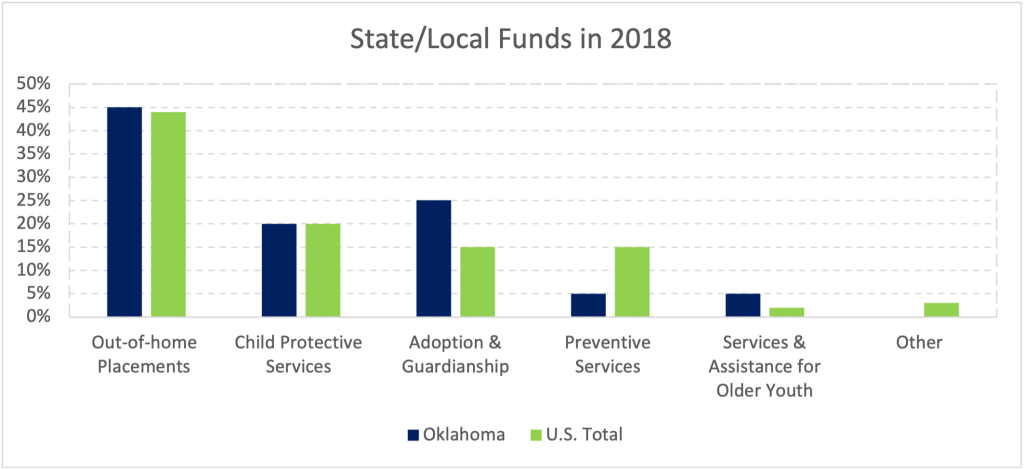
Preventive services aim to actively seek out children who suffer from abuse, neglect, and sexual abuse. The goal of these services is to save the children from their unfortunate circumstances in a timely manner to make it, so they do not suffer from abuse any longer than they already have. Preventive services are handled by the Oklahoma State Department of Human Service of Child Abuse and Neglect or the OKDHS. IN 2012 there were 44,232 children who OKDHS had investigated, and 9,842 children (22.5%) found substantiated findings of abuse and/or neglect. (The Oklahoma State Plan for the Prevention of Child Abuse and Neglect 14) With this large percentage in the findings, there has been a growing national consensus about the significance of investing in prevention services focusing on children, families, and communities. (The Oklahoma State Plan for the Prevention of Child Abuse and Neglect 13) The concerning part of this plan is the significant lack of money invested into preventive services in Oklahoma compared to the national average. To ensure that OKDHS can adequately carry out these preventive services, they need money, which is lacking from their budget. The OKDHS plans will only move forward by supporting communities to help families in need by involving local leaders, coordination between service providers, and advocacy at the local and state level. (The Oklahoma State Plan for the Prevention of Child Abuse and Neglect 12) Though the OKDHS can plan everything for better preventive services, only the communities can carry out future plans that will work best for each individual community, which leads this back to the community to help solve the problems of the foster care system.
Another significant problem within the foster care system is when children age out of the system. “Research consistently has shown that youth who age out of foster care do not receive the same type of support and assistance as many of their peers, and therefore may be at higher risk of experiencing homelessness.” (Crawford 3) The primary way to prevent this is by having children not aging out of the system. In Oklahoma, around 6-7% of youth aged out from 2008 to 2013, which is a significantly smaller percentage than the national average (Crawford 4). Despite only 6-7% of youth aging out, nearly 1 in 5 children who have been involved with foster care have experienced homelessness. (Crawford 4) Sometimes there is nothing wrong with the parent’s love and ability to care for their children, but instead, unfortunate circumstances get children into the foster care system. These unfortunate circumstances often include not having enough money to adequately feed their children or becoming homeless due to unforeseen circumstances. Growing up in such unstable environments makes it hard to succeed in life and is why those who have gone through the foster care system have such a big chance of ending up homeless again.
What can solve those issues is more community involvement to help cover what the foster care cannot in the specific community. For instance, in Stillwater, there is the Lions Meadows of Hope, the Saville Center for Child Advocacy, and the Payne County Youth Services. The main objective of the Lions Meadows of Hope is to reunite children with their families. They are partnered with the Oklahoma Department of Human Services to specifically recruit, train, certify, and support foster parents. (Lions Meadows of Hope 1) The Payne County Youth Services takes a different approach to ensure that children do not go into the foster care system by helping the families. They make sure to help those families by making sure they do not go homeless or hungry so that the kids can stay with their loving families.
There is an importance to have a solid community to support the foster care system like in Stillwater. According to the systems care coordinator in Contra Costa County,
“First it was necessary to educate the community and neighborhood service providers about community-based support before we could secure help within the neighborhoods. We routinely turn to our foster parents to recruit additional foster parents within their own neighborhoods. We are developing strategies to ensure our staff, including support and information technology staff and system partners, are active foster parent recruiters. People are willing to help but have to understand the needs and be engaged as true partners in addressing those needs.”
(A Closer Look: Community-Based Resources 3)
This statement shows the basic steps for helping reform the foster care system within a community. Different communities have different challenges when tackling the foster system, and the people who know those problems the best are the communities themself. The improvements come down to people who invest in their community will help it improve, and the foster care system is no exception.
Oklahoma State University has been able to help the foster care system mainly through the Greek community. Every Greek house is required to have one local philanthropy that they volunteer and raise money for. Since fraternities and sororities can maintain a distant and long-term relationship with the foster care system, one sorority that is close to the foster care system is Alpha Omicron Pi. Every week the sorority goes to the Saville Center to volunteer, attend banquets, and have a philanthropy event to raise money. By having Oklahoma State University offer additional positive, informal support to the children and families through events, the university can provide the extra support that the foster care system cannot do on its own. (Oklahoma. Foster Care System Improvement Task Force 2) The university allows the foster care system to stay localized, and children can remain in the community where they grew up in. Even though Oklahoma State University is only supporting from afar, any support for the system goes a long way.
Volunteering directly with the foster care system can be a difficult task within itself, and donating money is often an easier choice. I volunteered at the Saville Center for Child Advocacy because I had a connection with my sorority Alpha Omicron Pi. Without that connection, I would not have the volunteering experience to add to my paper. The reason why being able to volunteer at these places is because of the children. Many foster children are vulnerable and in a position to be taken advantage of, which is why they are so strict with who comes in a volunteer with the children. When I volunteered at the Saville Center, I was not allowed to have contact with the kids, and usually, only the staff was allowed to interact with the children. I wanted to talk to the staff, but I couldn’t, sadly because they were busy with work. I could tell in their facilities that they genuinely cared for the children and wanted the best for them. Everything was designed for children’s comfort in mind while being extremely neat. Being a part of such an organization brought joy to my soul. All we did was clean up the facilities, but by taking those simple chores away from the workers, they can focus their time directly on the children.
To help support the foster care system in your community, many ways to help can be done. For a few individuals, that might mean taking up a job in the foster care system or becoming a foster parent. You can donate to your community’s foster care system or volunteer there for those looking for less commitment. Even if you are not directly involved with the foster care system, the littlest amount of help adds up through time. I hope that you will be able to support your community’s foster care system.
Works Cited
A Closer Look: Community-Based Resources: Keystone to … – Child Welfare. Oct. 2009, https://www.childwelfare.gov/pubPDFs/community.pdf.
Child Welfare Agency Spending in Oklahoma in SFY 2018. https://www.childtrends.org/wp-content/uploads/2021/01/Oklahoma_SFY2018-CWFS_03.03.2021.pdf.
Crawford, Brandon L., et al. “Factors Influencing Risk of Homelessness among Youth in Transition from Foster Care in Oklahoma: Implications for Reforming Independent Living Services and Opportunities.” Child Welfare, vol. 94, no. 1, 2015, pp. 19–34, https://www.jstor.org/stable/48623502. Accessed 14 April 2022.
“Foster Care Agency in Payne County.” Lions Meadows of Hope, 15 Apr. 2022, https://lionsmoh.org/.
“Home.” Job Search, https://www.indeed.com/career/case-worker/salaries/OK).
“In Focus: For Overwhelmed Caseworkers, Protecting Kids Can Be a Struggle.” Children’s Rights, 15 Apr. 2014, www.childrensrights.org/newsletter-article/in-focus-for-overwhelmed-caseworkers-protecting-kids-can-be-a-struggle/.
Oklahoma, Foster Care System Improvement Task Force, and Oklahoma, Commission on Children and Youth. “Oklahoma Foster Care System Improvement Task Force March 15, 2012: Recommendations.” Oklahoma Digital Prairie – Your Information Hub for State Records, Archives, Pictures, Forms, and Online Resources., https://digitalprairie.ok.gov/digital/collection/stgovpub/id/48359.
The Oklahoma State Plan for the Prevention of Child Abuse and Neglect. https://www.ok.gov/health2/documents/2014%20-%202018%20State%20Prevention%20Plan%20FINAL.pdf.

 archiveoklahoma.com